
Get your Temporary Instruction Permit.
Once you are eligible, visit an Ohio BMV location, complete the vision screening and knowledge test, provide the required documents, and obtain your Temporary Instruction Permit Identification Card (TIPIC).

ONLINE TEEN DRIVER EDUCATION
FLEXIBLE ONLINE DRIVER EDUCATION
FOR NEW DRIVERS IN OHIO.

Take the course on any device. Your progress is saved automatically.
Once you are eligible, visit an Ohio BMV location, complete the vision screening and knowledge test, provide the required documents, and obtain your Temporary Instruction Permit Identification Card (TIPIC).
Complete the required 24 hours of classroom or online driver education and 8 hours of behind-the-wheel instruction. You must also complete the required supervised driving practice and hold your TIPIC for at least six months before taking the driving test. (Ohio BMV)
After completing the applicable training and practice requirements, schedule your Ohio driving and skills tests. Bring your TIPIC, required documentation, and a vehicle that meets the BMV's testing requirements. Once you pass, you can proceed with obtaining your driver's license. (Ohio BMV)
Choose the course that fits your Ohio learning goals.
Compare approval, the total cost, and the help you’ll get along the way.
Review current Ohio options and prices.
Ask what’s included before you enroll.
Take the next step toward confident driving in Ohio.
Find your course and start building good habits.
Review your course details and price before you enroll.

Short study sessions that fit around school and family life.
Pick up where you left off, on your own schedule.
Review your course and completion details before you enroll.
Our team can help with course, account, and certificate questions.
Quick answers for Ohio teens and parents.
Find more help on our full FAQ page.
You can apply for a Temporary Instruction Permit Identification Card beginning at age 15 years and 6 months. You must meet the BMV's documentation, vision, and knowledge-test requirements. (Ohio BMV)
Yes. Under Ohio's requirements effective September 30, 2025, new drivers under 21 must complete the required Class D driver education program before receiving a license. (Ohio BMV)
The Class D driver education program includes at least 24 hours of classroom or online instruction. Beginning drivers under 18 also need 8 hours of behind-the-wheel instruction. (Ohio BMV)
No. Online or classroom education covers the educational portion of the program, while behind-the-wheel instruction provides professional in-car training. Both can be required. (Ohio BMV)
If you are following the minor licensing pathway, you must hold your TIPIC for at least six months before obtaining your probationary driver's license. (Ohio BMV)
You need 50 hours of supervised driving, including at least 10 hours at night, in addition to the required driver education and professional driving instruction when those requirements apply. (Ohio BMV)
Yes, beginning drivers under 18 need 8 hours of behind-the-wheel instruction with a licensed driver training school. The Ohio BMV also identifies 8 hours of driving instruction as part of the Class D requirement for applicants ages 18 through 20. (Ohio BMV)
No. A TIPIC requires you to practice with an eligible licensed driver in the passenger seat. Additional restrictions apply depending on your age. (Ohio BMV)
You must pass the BMV knowledge test to obtain your TIPIC and later pass Ohio's driving and skills tests to obtain your driver's license. (Ohio BMV)
The test has a driving portion and a maneuverability portion. The driving portion evaluates basic vehicle-control and traffic skills, while the maneuverability portion tests your ability to move through the designated markers. (Ohio BMV)
If you are under 21 and fail a driving or skills test, you must wait two days before taking the test again. (Ohio BMV)
Drivers under 18 have restrictions on nighttime driving and passengers. The exact nighttime restriction depends on whether you are 16 or 17, and the passenger restriction generally limits you to one non-family passenger during the first 12 months unless a parent or guardian is present. (Ohio BMV)
You may need to complete an approved Abbreviated Adult Driver Training Course before attempting the driving test again, unless you completed qualifying driver training within the previous 12 months. (Ohio BMV)
Qualifying limited-term applicants generally must complete the full driver-training requirements, including 24 hours of classroom or online instruction, 8 hours of behind-the-wheel training, and applicable supervised driving. Exceptions may apply. (Ohio Legislature)
No. Completing the online education portion is only one part of the licensing process. You still need to complete the applicable behind-the-wheel training, supervised practice, BMV testing, and other requirements before receiving your license.
Licensing information: Ohio Bureau of Motor Vehicles →
Find your next step, or get help from our team.
Ohio's licensing process begins with a Temporary Instruction Permit Identification Card, or TIPIC. You can apply for a TIPIC beginning at age 15 years and 6 months. After meeting the permit requirements, completing the required driver education and behind-the-wheel training, gaining supervised driving experience, and passing the required tests, you can move on to your driver's license. (Ohio BMV)
Ohio's requirements now extend beyond teenagers. Beginning September 30, 2025, new drivers under 21 must complete the required Class D driver education program before obtaining a license. The program consists of 24 hours of classroom or online instruction and 8 hours of behind-the-wheel training. (Ohio BMV)
The general process is:
Your course depends on your age and licensing situation.
Your first licensing step is obtaining the Temporary Instruction Permit Identification Card.
To apply, you must provide the BMV with acceptable documentation establishing information such as your legal name, date of birth, Social Security number if assigned, Ohio residency, and citizenship or legal presence. Applicants also complete the required vision screening and knowledge test. (Ohio BMV)
The Ohio knowledge test covers traffic laws and road signs. Preparing before you visit the BMV can help you feel more comfortable with the testing process.
If you are under 18, a responsible adult must also meet the BMV's requirements to co-sign for your TIPIC. (Ohio BMV)
A TIPIC does not allow you to drive by yourself. If you are under 16, you must have a parent, guardian, or licensed driving instructor in the passenger seat. At age 16 or older, you may practice with an eligible licensed driver age 21 or older, subject to Ohio's additional permit restrictions. (Ohio BMV)
After obtaining your permit, complete the driver education requirement that applies to you.
For beginning drivers under 18, Ohio's approved driver education program includes at least 24 hours of classroom or online instruction. Beginning drivers under 18 also need at least 8 hours of behind-the-wheel instruction from a licensed driver training school. (Ohio Revised Code)
Ohio also requires driver education for new drivers ages 18 through 20 under the rules that took effect September 30, 2025. The Ohio BMV identifies the Class D requirement for ages 18 through 20 as 24 hours of classroom or online instruction plus 8 hours of driving instruction. (Ohio BMV)
Online driver education and behind-the-wheel instruction are separate portions of the training process. Completing an online course does not eliminate the required in-car training.
Driver education teaches the classroom portion of the program, but you also need actual driving experience.
For applicants under 21 following the minor licensing pathway, Ohio requires:
The 50 hours of supervised driving are in addition to the professional behind-the-wheel instruction. (Ohio BMV)
Keep your supervised-driving records because the BMV requires the applicable driving affidavit or log when you complete the testing process. (Ohio BMV)
After you have completed the applicable training, practice, and permit requirements, you can schedule your driving and skills tests.
Ohio's testing process includes both a driving portion and a maneuverability portion. During the driving test, you may be evaluated on tasks such as stopping and starting, turning, backing up, using signals, maintaining the proper lane, and keeping a safe following distance. The maneuverability test evaluates your ability to move the vehicle forward and backward through markers. (Ohio BMV)
Bring your TIPIC, the required supervised-driving documentation, and a vehicle in acceptable condition for testing. For applicants under 21, the BMV requires the applicable BMV 5791 Fifty-Hour Affidavit at the driving test. (Ohio BMV)
If you fail a driving or skills test and are under 21, Ohio requires a two-day waiting period before you can retest. (Ohio BMV)
If you receive a probationary driver's license before turning 18, Ohio places restrictions on when you may drive and who you may carry.
At age 16, you generally cannot drive between midnight and 6:00 a.m. unless an applicable exception allows it. At age 17, the restricted period generally changes to 1:00 a.m. through 5:00 a.m. Exceptions include certain driving accompanied by an appropriate adult and qualifying work-related travel. (Ohio BMV)
For the first 12 months, probationary drivers are also restricted to carrying no more than one passenger who is not a family member unless a parent or guardian is present. (Ohio BMV)
Ohio changed its driver-training requirements effective September 30, 2025. New drivers under 21 must complete the required driver education and training before receiving a license. The Class D program includes 24 hours of classroom or online instruction and 8 hours of behind-the-wheel training. (Ohio BMV)
This means waiting until age 18, 19, or 20 does not automatically eliminate the driver-training requirement for a first Ohio driver's license.
Ohio restricts drivers from using or holding a cell phone or other electronic device while driving, subject to specific legal exceptions. The restrictions are particularly important for new drivers, so make sure you understand the current Ohio hands-free requirements before driving.
Ohio requires drivers to maintain proof of financial responsibility. Before driving, make sure you have the insurance or other qualifying financial-responsibility coverage required under Ohio law.
If you are 21 or older and fail your first maneuverability or road test, Ohio may require you to complete an Abbreviated Adult Driver Training Course before taking the driving test again.
The Ohio BMV lists four approved combinations. They include a 4-hour in-person or online course followed by either 4 hours of professional behind-the-wheel instruction or 24 hours of driving with a licensed driver age 21 or older. The 24-hour supervised-driving option has a four-hour-per-day limit and requires the applicable BMV 5789 affidavit. (Ohio BMV)
You must provide proof of the required driver-training course before your second testing attempt. (Ohio BMV)
If you are a temporary resident applying for an Ohio Limited Term Driver License, separate training requirements may apply.
Ohio's current rules generally require qualifying limited-term applicants to complete the full driver-training course, including 24 hours of classroom or online instruction and 8 hours of behind-the-wheel training, as well as the applicable supervised-driving requirement. Certain exemptions may apply, so confirm your individual requirements with the Ohio BMV before beginning the licensing process. (Ohio Legislature)
TeenDrivingCourse provides online driver education for Ohio students who need an approved online classroom component.
The online portion and professional driving instruction serve different purposes. Completing the online course does not replace the required behind-the-wheel instruction, supervised practice, knowledge testing, or driving and skills testing.
Follow the course requirements carefully and complete each part of Ohio's licensing process that applies to your age and situation.
The knowledge test is one of the first testing requirements you encounter when applying for your TIPIC. Reviewing Ohio traffic laws and road signs before visiting the BMV can help you prepare.
Use your driver education material to review the information covered by Ohio's licensing process. Practice testing can also help you identify areas that need more study before you take the actual BMV knowledge test.
For the latest testing information, documents, and scheduling instructions, check the Ohio BMV before your appointment.
Build confidence one question at a time. Try a few practice questions, then keep preparing for your Ohio knowledge test.
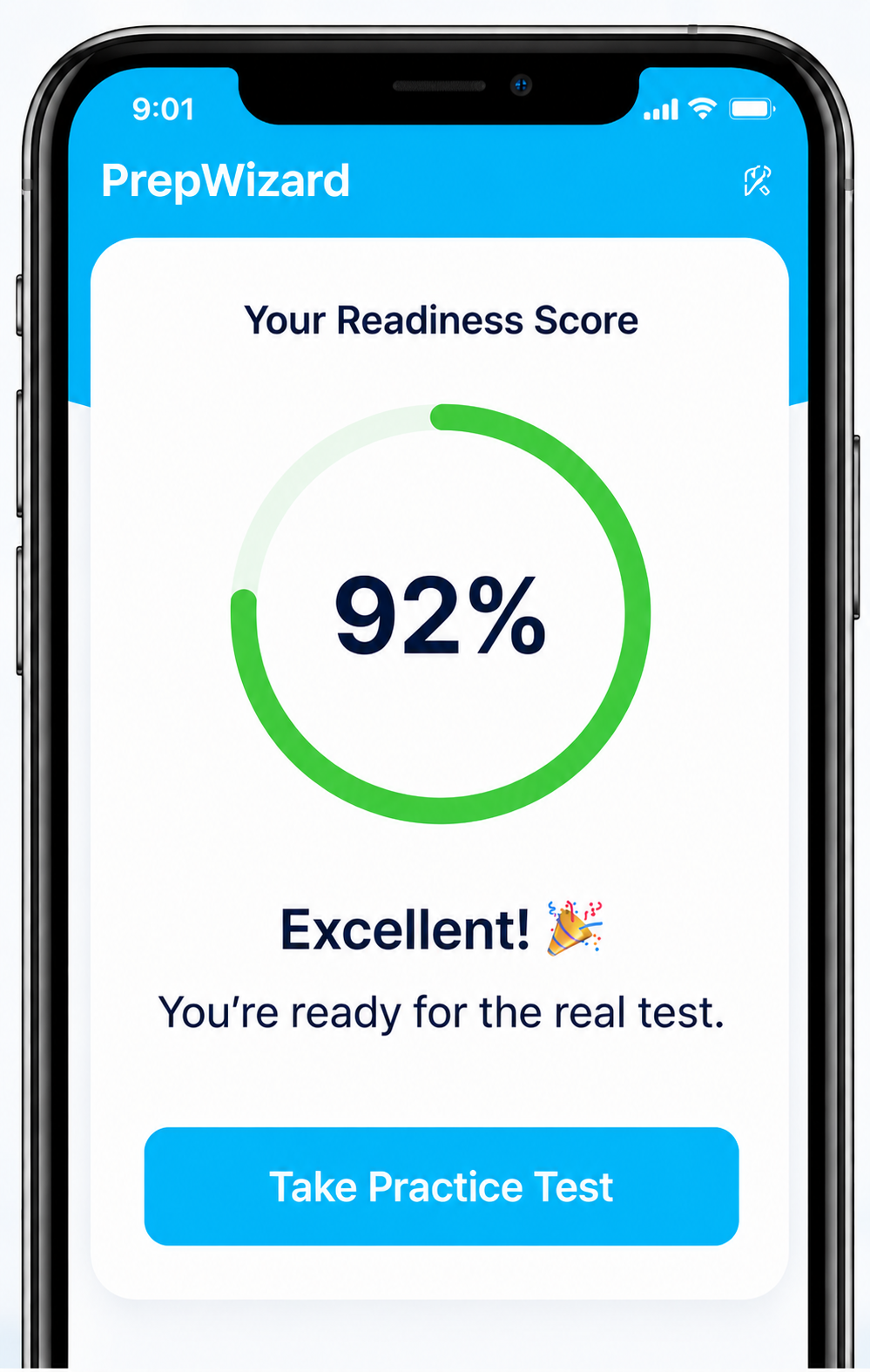 Sample readiness screen
Choose an answer to continue.
Questions about your course? Call 1-800-482-6593.
Choose your county or area to find local driver education information and links to its cities and communities.
Place names and county relationships: 2020 U.S. Census reference files. Includes county equivalents and census-designated communities.