
Build your Arizona driving knowledge.
Start the self-paced Teendrivingcourse program to learn traffic laws, road signs, right-of-way, hazard awareness, and defensive-driving fundamentals before and during your supervised driving practice.

ONLINE TEEN DRIVER EDUCATION
FLEXIBLE ONLINE DRIVER EDUCATION
FOR NEW DRIVERS IN ARIZONA.

Take the course on any device. Your progress is saved automatically.
Start the self-paced Teendrivingcourse program to learn traffic laws, road signs, right-of-way, hazard awareness, and defensive-driving fundamentals before and during your supervised driving practice.
Review the Arizona Driver License Manual and use practice questions to prepare for the 30-question written knowledge test. You need a score of at least 80% to pass, whether you take the test at an MVD office or through the Permit Test @ Home option.
After getting your Graduated Instruction Permit at 15½, complete the applicable supervised-driving requirement, hold your permit for at least six months, and meet the requirements for the Class G license. Depending on the qualification path you choose, you may also need to pass the road test.
Choose the course that fits your Arizona learning goals.
Compare approval, the total cost, and the help you’ll get along the way.
Review current Arizona options and prices.
Ask what’s included before you enroll.
Take the next step toward confident driving in Arizona.
Find your course and start building good habits.
Review your course details and price before you enroll.

Short study sessions that fit around school and family life.
Pick up where you left off, on your own schedule.
Review your course and completion details before you enroll.
Our team can help with course, account, and certificate questions.
Quick answers for Arizona teens and parents.
Find more help on our full FAQ page.
You can apply for a Graduated Instruction Permit at 15 years and 6 months. You must pass the required knowledge and vision tests and complete the MVD's application requirements.
Arizona provides several education and supervised-practice paths. Depending on the option you use, you may complete supervised driving hours or an eligible driver education program.
The standard practice option requires at least 30 hours, including at least 10 hours at night. A separate qualifying path allows 20 hours, including at least 6 hours at night, when the specified qualifying course has been completed.
Yes. Eligible Arizona teens under 18 can take the official Permit Test @ Home when a parent or legal guardian administers the test through an AZ MVD Now account.
The written knowledge test has 30 multiple-choice questions. You need at least 80% to pass.
The questions are based on the Arizona Driver License Manual. Arizona also provides official practice tests using information from that manual.
If you are under 18, you generally must hold the permit for at least six months before qualifying for a Class G license. The permit itself is valid for 12 months.
A licensed driver who is at least 21 years old must sit in the seat beside you while you drive with the instruction permit.
You must be at least 16 and meet the applicable permit, six-month holding period, practice or education, testing, and parental-consent requirements.
Some qualifying programs can change the requirements, but you should distinguish the specific options. Arizona's current MVD guidance provides a 20-hour practice path for certain qualifying courses and a separate road-test-waived path for eligible driver education programs.
Do not assume that it can. Teendrivingcourse's online course is described as a supplemental educational resource, while Arizona requires specific qualifying programs for reduced practice or the road-test-waived option.
Generally, you may have no more than one passenger under 18 who is not your sibling. The restriction has exceptions when the passengers are siblings or a parent or legal guardian is seated beside you.
Generally, no. Exceptions include certain situations involving a legal guardian, employment, school-sanctioned activities, religious activities, or a family emergency.
Arizona prohibits drivers from physically holding or supporting a portable wireless communication device while driving and restricts texting and similar communications, subject to limited exceptions.
You can continue using your Class G license or switch to a regular Class D license after turning 18.
Licensing information: Arizona Motor Vehicle Division →
Find your next step, or get help from our team.
Arizona's graduated licensing system lets teens begin the process at 15 years and 6 months with a Graduated Instruction Permit. At age 16, an eligible teen can move to a Class G graduated driver's license after meeting the permit, driving-experience, and testing requirements.
The Arizona Department of Transportation's Motor Vehicle Division, or MVD, handles the licensing process. Your path can involve supervised driving practice, an approved driver education program, or both, depending on the option you choose.
The basic progression is:
You can begin the Arizona teen licensing process when you are at least 15 years and 6 months old. You must pass the non-commercial knowledge test and then complete the remaining permit application requirements, including providing original supporting documents, obtaining parent or guardian approval, passing the vision test, and having your photo taken at an MVD or authorized location.
The Arizona knowledge test contains 30 multiple-choice questions, and you need at least 80% to pass. The questions are based on the Arizona Driver License Manual.
Arizona also offers Permit Test @ Home. Teens under 18 can take the official knowledge test online when a parent or legal guardian administers it through an AZ MVD Now account. After passing, you still need to complete the process of obtaining the instruction permit.
Once you have your instruction permit, you must have a licensed driver who is at least 21 years old seated beside you while you drive. The permit is valid for 12 months and must generally be held for at least six months before you can qualify for a graduated license.
Arizona provides more than one way for a teen to satisfy the education and driving-experience requirements.
Under the standard practice option, your parent or guardian must certify at least 30 hours of supervised driving, including at least 10 hours at night.
A separate option allows 20 hours of supervised driving, including at least 6 hours at night, when the teen has completed the qualifying Traffic Survival School or certified defensive-driving course specified by the Arizona MVD.
Arizona also provides a driver education option through a high school or privately operated driver education program. Under the MVD's current teen-driver guide, completing an eligible driver education program and providing proof of completion within the required period can qualify the teen for the road-test-waived path.
These options are different, so make sure you know which path you are completing before relying on a course to reduce your practice requirement or waive a test.
You must be at least 16 to receive an Arizona Class G graduated driver's license. If you are under 18, you generally must have held your Graduated Instruction Permit for at least six months and have parent or legal guardian approval.
If you qualify through the supervised-practice option, you must complete the required practice hours and take the road test. Arizona's MVD also has a road-test-waived path for qualifying applicants who complete an eligible high school or privately operated driver education program and provide the required proof.
For a road test, you need an eligible vehicle with current registration and liability insurance. Applicants under 18 must also have a parent or legal guardian accompany them.
A Class G license comes with additional restrictions during your first six months.
During the first six months, you generally cannot drive with more than one passenger under 18 who is not your sibling. This restriction does not apply when your siblings are the passengers or when a parent or legal guardian with a valid license is seated beside you.
During the first six months, you generally cannot drive between midnight and 5:00 a.m. Exceptions include having a legal guardian with a valid driver's license seated beside you or driving for certain employment, school, religious-activity, or family-emergency purposes specified by Arizona.
Arizona prohibits drivers from physically holding or supporting a portable wireless communication device while driving. The law also restricts writing, sending, or reading text-based communications while driving, with limited hands-free and emergency exceptions.
For a new driver, the safest practice is simple: put the phone away before you start driving and avoid handling it while the vehicle is moving.
Violating Arizona's graduated-license restrictions can lead to penalties and extend the period during which the restrictions apply. The MVD lists different consequences for first, second, and third convictions, including longer restrictions or suspension for later convictions.
Arizona requires liability insurance for vehicles operated on its roads. The current minimum coverage is:
The vehicle must be covered through an insurer authorized to do business in Arizona.
The Arizona written knowledge test contains 30 multiple-choice questions based on the Arizona Driver License Manual, and you need at least 80% to pass. Arizona also provides official practice tests based on the same manual.
Study the manual carefully and use practice questions to become familiar with the types of information covered on the examination. You can take the official permit test at an MVD office or, if eligible, through Permit Test @ Home with a parent or legal guardian.
Teendrivingcourse provides online driver education that can be used as a supplemental learning resource. Its website describes the course as an online program available from a computer with internet access and states that the course is designed to supplement state-approved driver education rather than automatically satisfy a state's licensing requirements.
For Arizona, do not assume that completing the Teendrivingcourse online program reduces the required supervised-driving hours or qualifies you for the road-test-waived driver education option. Arizona has specific requirements for the programs that qualify for those benefits.
You can use an online course to build your knowledge of traffic laws, safe-driving practices, road signs, and defensive-driving concepts while you prepare for the Arizona licensing process and complete your supervised practice.
Your Class G license carries passenger, nighttime, and wireless-device restrictions during the first six months. Follow those restrictions and maintain a safe driving record while you gain more experience.
After you turn 18, Arizona allows you to continue using your Class G license or switch to a regular Class D license.
If your licensing path requires a road test, you must meet the applicable eligibility requirements before scheduling it. For teens, that includes holding the instruction permit for at least six months.
Use your supervised practice time to build real driving skills. Practice traffic signs, lane changes, turns, stopping, following distance, parking, and other everyday driving tasks so you are prepared for the situations evaluated during the road test.
Build confidence one question at a time. Try a few practice questions, then keep preparing for your Arizona knowledge test.
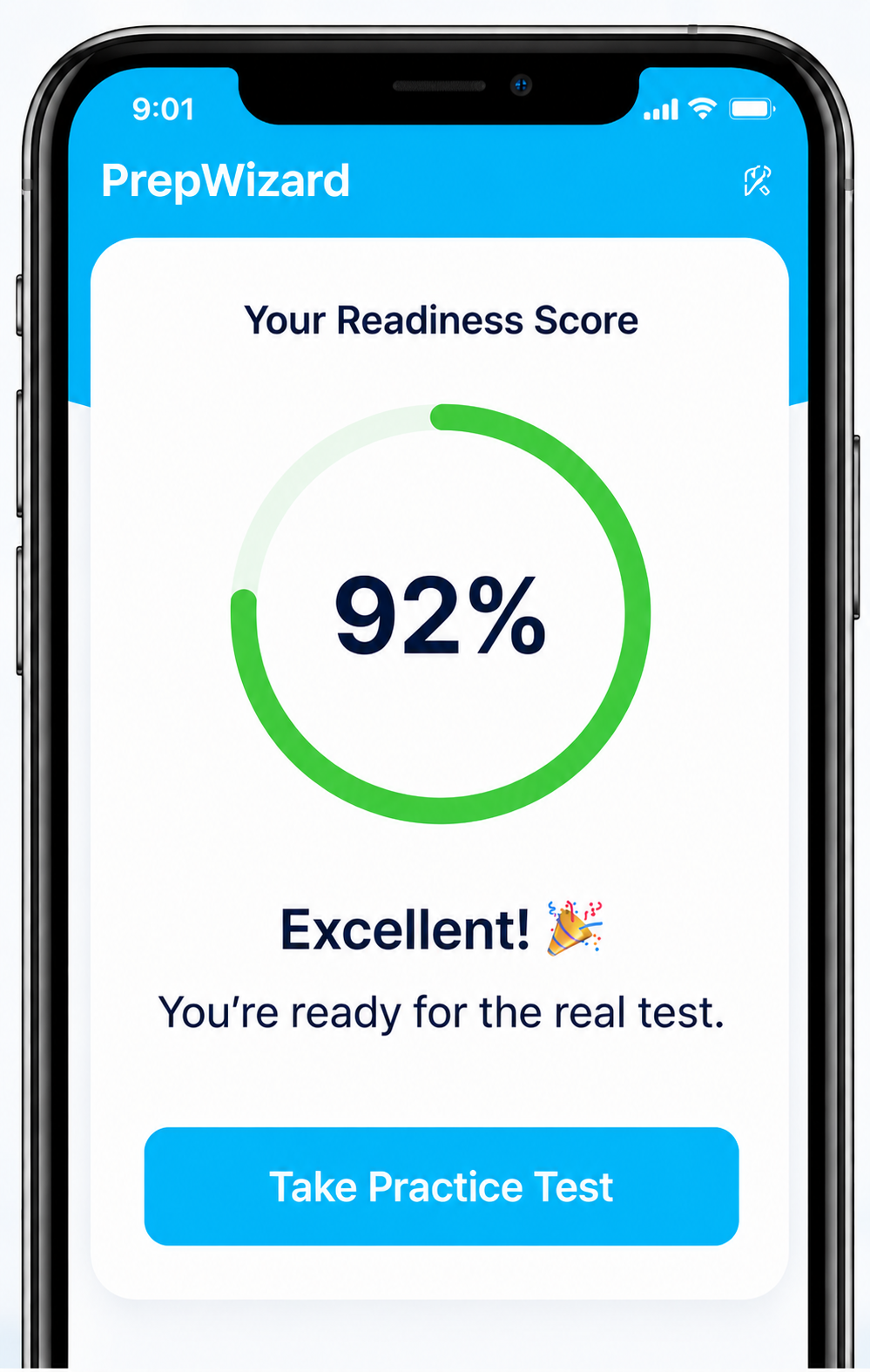 Sample readiness screen
Choose an answer to continue.
Questions about your course? Call 1-800-482-6593.
Choose your county or area to find local driver education information and links to its cities and communities.
Place names and county relationships: 2020 U.S. Census reference files. Includes county equivalents and census-designated communities.