
Build your Arkansas driving knowledge.
Start the self-paced Teendrivingcourse program to learn Arkansas traffic laws, road signs, right-of-way rules, hazard awareness, and defensive-driving fundamentals before you begin supervised driving.

ONLINE TEEN DRIVER EDUCATION
FLEXIBLE ONLINE DRIVER EDUCATION
FOR NEW DRIVERS IN ARKANSAS.

Take the course on any device. Your progress is saved automatically.
Start the self-paced Teendrivingcourse program to learn Arkansas traffic laws, road signs, right-of-way rules, hazard awareness, and defensive-driving fundamentals before you begin supervised driving.
Study the Arkansas Driver License Study Guide and use practice questions to review the information covered by the State Police knowledge examination. Build your knowledge before your testing appointment so you are ready for the written and skills portions of the licensing process.
Get your instruction permit, practice with a licensed driver who is at least 21, and maintain the clean driving record required for the next license level. At 16, you can move to an intermediate license after meeting Arkansas's testing and record requirements.
Choose the course that fits your Arkansas learning goals.
Compare approval, the total cost, and the help you’ll get along the way.
Review current Arkansas options and prices.
Ask what’s included before you enroll.
Take the next step toward confident driving in Arkansas.
Find your course and start building good habits.
Review your course details and price before you enroll.

Short study sessions that fit around school and family life.
Pick up where you left off, on your own schedule.
Review your course and completion details before you enroll.
Our team can help with course, account, and certificate questions.
Quick answers for Arkansas teens and parents.
Find more help on our full FAQ page.
You can apply for an Arkansas instruction permit at age 14 after passing the required knowledge and vision tests. You must drive with a qualified licensed driver seated beside you.
No. Arkansas does not require a logged number of supervised-driving hours for the intermediate license. The graduated system instead places significant emphasis on testing and maintaining the required clean driving record.
A licensed driver who is at least 21 years old must occupy the seat beside you. You cannot drive by yourself with an instruction permit.
You must pass the knowledge examination and vision test to receive an instruction permit. Arkansas also requires the applicable skills testing before an eligible teen receives a learner's or intermediate license.
The Arkansas State Police administers driver knowledge and skills testing at testing locations throughout the state. You should check the State Police testing schedule and location information before your appointment.
An eligible driver between 14 and 16 can receive a learner's license after completing the required instruction-permit testing, including the knowledge, vision, and skills tests. The learner's license remains subject to restrictions.
You can qualify for an intermediate license beginning at age 16 after meeting the applicable testing, permit, and driving-record requirements.
No. A licensed driver who is at least 21 must be seated beside you while you drive under the learner's license restrictions.
Generally, you may have no more than one unrelated minor passenger unless a licensed driver who is at least 21 is seated in the front seat.
Generally, no. Exceptions include certain trips involving a licensed driver age 21 or older, school or church activities, work, or an emergency.
No. Arkansas prohibits learner's and intermediate license holders from using a cell phone or interactive wireless device while driving, including hands-free use, except for an emergency.
Arkansas requires the applicable record to be free of a serious accident or serious traffic conviction for six months before the learner-to-intermediate progression and 12 months for the regular license stage. A disqualifying record can delay licensing.
No. Teendrivingcourse is an educational resource and does not replace the Arkansas State Police knowledge or skills examinations.
No. Online education does not replace actual practice behind the wheel with the qualified supervising driver required by Arkansas. Arkansas does not impose a specific logged-hour total, but supervised driving remains an important part of learning to drive safely.
The minimum liability limits are $25,000 for bodily injury or death of one person, $50,000 for two or more people, and $25,000 for property damage.
Licensing information: Arkansas Driver Services →
Find your next step, or get help from our team.
Arkansas uses a graduated licensing system that moves young drivers through an instruction permit, learner's license, intermediate license, and eventually a regular Class D license. You can begin the process at 14, qualify for an intermediate license at 16, and become eligible for a regular unrestricted license at 18.
Driver testing is administered by the Arkansas State Police, rather than at a traditional DMV testing counter. The State Police provides the driver study guide, knowledge testing, skills testing, and testing locations throughout the state.
Arkansas does not require a specific number of logged supervised-driving hours before you can move through the graduated licensing system. Instead, the state focuses on your age, completion of the required tests, and maintaining the required driving record.
The basic progression is:
At age 14, you can apply for an Arkansas instruction permit. You must pass the knowledge examination and vision test. The instruction permit allows you to practice driving with a licensed driver who is at least 21 years old seated beside you.
The current Arkansas Driver License Study Guide explains that the instruction permit is issued for two years from the date you pass the knowledge exam. All passengers must wear seat belts while you are driving with the permit.
For applicants under 18, the Arkansas State Police also requires documentation such as proof of identity and school enrollment or graduation. Check the current testing checklist before your appointment so you bring the documents required for your situation.
Arkansas separates the instruction permit from the learner's license. After completing the required knowledge, vision, and skills testing, an eligible driver between 14 and 16 can receive a learner's license.
The learner's license remains restricted. You must continue driving with a licensed driver who is at least 21 years old seated beside you, and all passengers must wear seat belts. You also cannot use a cell phone or other wireless communication device while driving, except for an emergency.
Your driving record also matters. Arkansas requires the record to be free of a serious accident or conviction for a serious traffic violation during the applicable six-month period before moving forward.
Arkansas does not use a mandatory 40-hour or similar supervised-driving log as a condition of obtaining an intermediate license. The state instead places significant emphasis on maintaining a clean driving record during the graduated licensing period.
Even without a required hour total, supervised practice is important. Use your time with an experienced adult to work on traffic awareness, following distance, lane control, turns, parking, hazard recognition, and other everyday driving skills.
The goal is to arrive at the next testing stage with real experience, not simply the minimum legal eligibility.
An intermediate license is available beginning at age 16 when you meet the applicable Arkansas requirements. The State Police materials require the applicant to have the necessary instruction-permit testing completed and to meet the required driving-record conditions.
The intermediate license gives you more independence than the learner's license, but restrictions apply during the restricted period. Your license records the restricted period, and the applicable restrictions must be followed until that period ends.
An intermediate driver generally cannot carry more than one unrelated minor passenger unless a licensed driver who is at least 21 years old is seated in the front seat.
The passenger rule is intended to limit distractions while a new driver gains experience. Family members who fall within Arkansas's specified exceptions are treated differently under the law.
An intermediate driver generally cannot drive between 11:00 p.m. and 4:00 a.m. unless a licensed driver who is at least 21 is present or an exception applies. The listed exceptions include travel to or from school activities, church activities, work, or an emergency.
Everyone riding in the vehicle must wear a seat belt. This requirement applies while you are driving under the learner's and intermediate licensing restrictions.
Arkansas prohibits learner's and intermediate license holders from using a cell phone or interactive wireless communication device while driving, including hands-free use, except for an emergency.
For a new driver, the safest approach is straightforward: put the phone away before you begin driving and leave it alone until the vehicle is parked.
Your driving record is an important part of Arkansas's graduated licensing system. The Arkansas State Police states that an applicant's record must be free of a serious accident or conviction for a serious traffic violation for the applicable six-month or 12-month period. A violation can delay progression to the next license level.
For the intermediate stage, the relevant record period is six months. For a regular Class D license at 18, the applicable clean-record period is 12 months.
That makes supervised practice especially important. Use the learner period to develop safe habits before you begin driving with fewer restrictions.
Arkansas requires liability insurance for motor vehicles operated in the state. The current minimum coverage is:
These are the state's minimum liability limits.
The Arkansas State Police provides the official Arkansas Driver License Study Guide and an official practice test for people preparing for the driver license examination. The study guide covers Arkansas rules of the road and safe-driving practices and is intended to help applicants prepare for both the knowledge and skills portions of the examination.
Review the study guide carefully before your testing appointment. Focus on traffic laws, signs, safe-driving practices, and the other information covered by the official materials.
The Arkansas State Police also warns that it is not associated with third-party websites offering practice tests. Use the official study materials to understand what Arkansas expects on its examination.
Teendrivingcourse provides an online driver education course that can be used as an educational resource while you prepare for Arkansas licensing. Its Arkansas FAQ describes the course primarily as an education tool for learning safe-driving basics and preparing for Arkansas written examinations and road tests.
The same FAQ advises students to check with the appropriate Arkansas licensing authority to determine whether the course satisfies any applicable driver education requirement. Because Arkansas's licensing process does not depend on a required number of supervised-driving hours, Teendrivingcourse should not be presented as replacing a state-required practice-hour log.
You can use online study to build knowledge before and during supervised driving. Your actual driving experience still needs to come from practicing behind the wheel with a qualified supervising driver.
The intermediate license is a restricted license for drivers between 16 and 18. During the restricted period, follow the passenger, nighttime, seat-belt, and wireless-device rules that apply to your license.
At age 18, you become eligible for a regular Class D license if you meet the applicable requirements, including the required clean driving record. The Class D license is the non-restricted license for drivers age 18 and older.
Arkansas State Police testing sites administer skills testing as part of the driver licensing process. Testing is scheduled through the State Police system, and testing locations and schedules vary by troop area.
Before taking the skills test, use your supervised driving time to practice the fundamentals you will need behind the wheel. Work on safe turns, lane positioning, stopping, traffic awareness, parking, and other everyday driving skills.
Build confidence one question at a time. Try a few practice questions, then keep preparing for your Arkansas knowledge test.
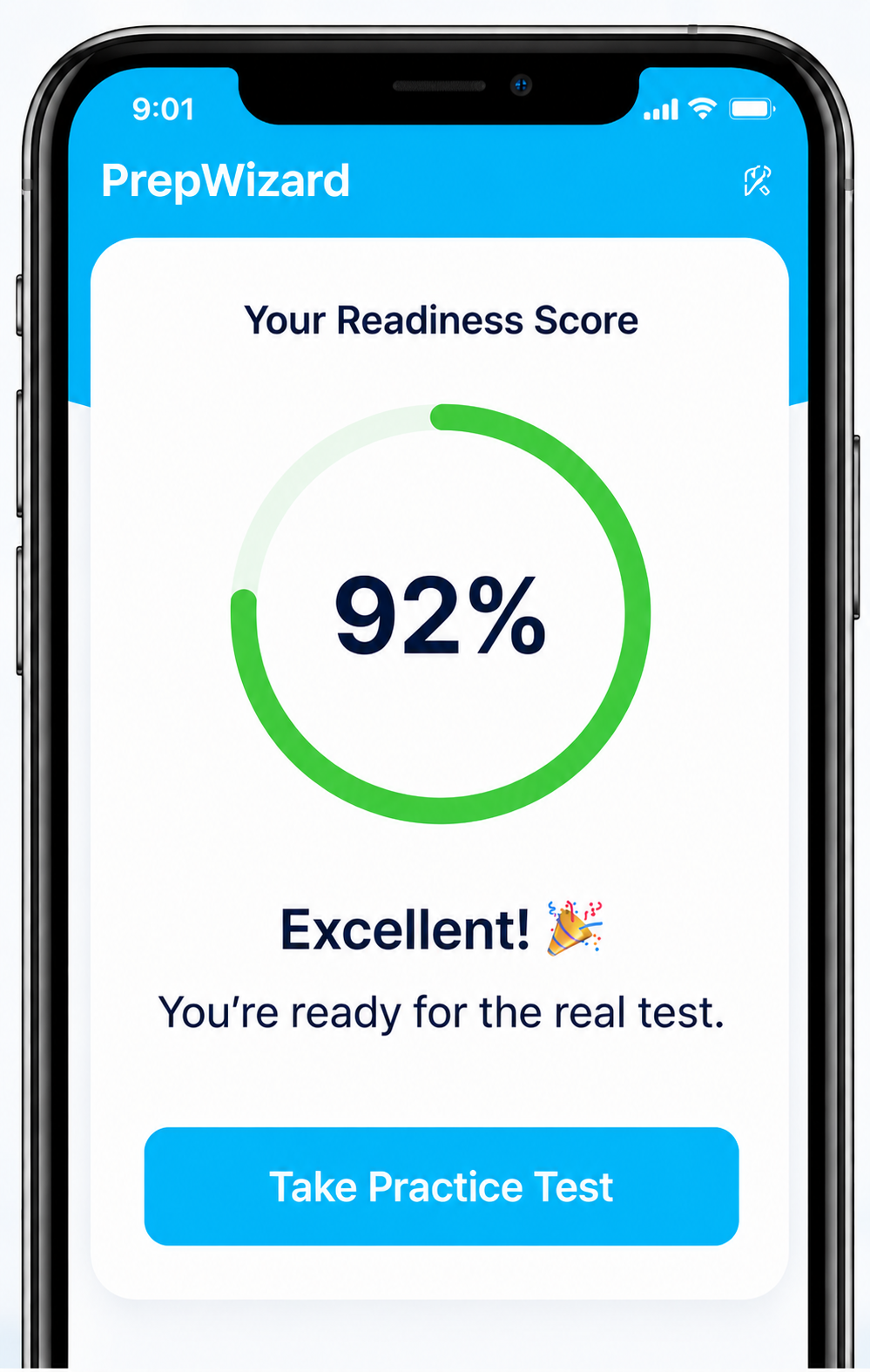 Sample readiness screen
Choose an answer to continue.
Questions about your course? Call 1-800-482-6593.
Choose your county or area to find local driver education information and links to its cities and communities.
Place names and county relationships: 2020 U.S. Census reference files. Includes county equivalents and census-designated communities.