
Prepare for your learner's permit.
Use the self-paced Teendrivingcourse online course to review Connecticut traffic rules, road signs, hazard recognition, and safe driving concepts before taking the DMV knowledge test.

ONLINE TEEN DRIVER EDUCATION
FLEXIBLE ONLINE DRIVER EDUCATION
FOR NEW DRIVERS IN CONNECTICUT.

Take the course on any device. Your progress is saved automatically.
Use the self-paced Teendrivingcourse online course to review Connecticut traffic rules, road signs, hazard recognition, and safe driving concepts before taking the DMV knowledge test.
At age 16, complete the required Connecticut Work Zone Safety Course, pass the DMV vision test and 25-question knowledge test, and obtain your learner's permit.
Follow a Connecticut-approved commercial, secondary school, or home-training route, complete the required training and 40 hours of practice driving, meet the applicable permit-holding period, and pass the road test.
Choose the course that fits your Connecticut learning goals.
Compare approval, the total cost, and the help you’ll get along the way.
Review current Connecticut options and prices.
Ask what’s included before you enroll.
Take the next step toward confident driving in Connecticut.
Find your course and start building good habits.
Review your course details and price before you enroll.

Short study sessions that fit around school and family life.
Pick up where you left off, on your own schedule.
Review your course and completion details before you enroll.
Our team can help with course, account, and certificate questions.
Quick answers for Connecticut teens and parents.
Find more help on our full FAQ page.
You must be at least 16 years old to apply for a Connecticut learner's permit. You must also complete the required Work Zone Safety Course and pass the vision and 25-question knowledge tests.
The knowledge test has 25 questions, and you need at least 20 correct answers to pass. The test is based on the Connecticut Driver's Manual.
Yes. Drivers who are 16 or 17 must complete Connecticut's required driver training through an approved commercial school, secondary school program, or qualifying home-training route.
No. Teendrivingcourse is a supplemental study resource and does not replace the required Connecticut driver training, safe-driving instruction, parent training, or required practice driving.
You must complete at least 40 hours of behind-the-wheel, on-the-road practice if you are 16 or 17. Those hours can be completed through a combination of approved school and qualified parent or trainer instruction.
The required period is at least 120 days after qualifying commercial or secondary school training, or at least 180 days for the home-training route.
Yes. A parent or legal guardian of a 16- or 17-year-old permit holder must complete two hours of training about teen driving laws and risks.
No. A 16- or 17-year-old learner's permit holder must drive with an authorized supervising adult, such as a parent, legal guardian, licensed instructor, or qualified trainer.
No. Connecticut prohibits cell phone and mobile electronic device use while driving, including hands-free use, for learner's permit holders.
Passenger restrictions apply during your first year as a 16- or 17-year-old licensed driver. The first six months have the strictest limits, while immediate family members may be added during the second six months.
Generally, no. Until you turn 18, Connecticut restricts driving during those hours unless a qualifying exception applies, such as employment, school, religious activities, or medical necessity.
The amount depends on your training route. Commercial and secondary school programs use 30 hours of classroom instruction, while home training includes the equivalent of 22 hours of classroom-type instruction plus the required eight-hour Safe Driving Practices course.
Yes. The required driver education documentation comes from the Connecticut-approved training program you complete, and the qualifying driving school sends the required certificate electronically to the DMV.
Connecticut requires at least $25,000 in bodily injury liability per person, $50,000 per accident, and $25,000 in property damage liability. Proof of qualifying insurance is also required for the road test.
Once you have completed the required training, 40 hours of practice, parent training, and the applicable 120- or 180-day permit period, you can proceed to the road test. Passing the road test allows you to obtain your Connecticut driver's license, subject to the restrictions that apply until age 18.
Licensing information: Connecticut DMV →
Find your next step, or get help from our team.
Connecticut allows teens to begin the licensing process at age 16. You first obtain a learner's permit by completing the required Work Zone Safety Course, passing a vision test, and passing the DMV's 25-question knowledge test.
For drivers ages 16 and 17, Connecticut also requires a state-defined driver training program before the road test. You must complete the required classroom and safe-driving instruction, parent training, and 40 hours of behind-the-wheel practice. The exact training route determines whether you can take the road test after holding your permit for at least 120 days or 180 days.
Teendrivingcourse can serve as a supplemental study resource, but it does not replace Connecticut's required driver training through an approved commercial school, secondary school program, or qualifying home-training route.
Before getting a learner's permit, Connecticut requires new drivers to complete the free online Work Zone Safety Course. After completing that step, you can move on to the learner's permit process.
The Connecticut DMV bases the learner's permit knowledge test on the Connecticut Driver's Manual. Studying the manual and practicing test questions can help you become familiar with the material before your appointment.
You can apply for a Connecticut learner's permit when you are at least 16. You must pass both a vision test and a 25-question knowledge test. The DMV states that you need at least 20 correct answers to pass the knowledge test.
Your learner's permit lets you begin supervised driving practice. While you hold the permit, you cannot drive alone. You may drive with a parent or legal guardian, a licensed driving instructor, or a qualified trainer who meets Connecticut's age and licensing requirements.
Learner's permit holders also cannot use a cell phone or other mobile electronic device while driving, including hands-free devices. All passengers must use permanently installed seat belts.
Connecticut requires 16- and 17-year-olds to complete driver training through an approved route. Your options include a Connecticut-licensed commercial driving school, a secondary school driver education program, or qualifying home training.
For commercial or secondary school training, the program includes 30 hours of classroom instruction, the required safe driving practices instruction, and two hours of parent training. You must also receive at least eight hours of behind-the-wheel instruction from a Connecticut-licensed commercial or secondary school to qualify for the 120-day road-test timeline.
Home training follows a different structure. It includes the equivalent of 22 hours of classroom-type instruction, an eight-hour Safe Driving Practices course through a commercial or secondary school, the two-hour parent or legal guardian training requirement, and 40 hours of practice driving with a qualified trainer.
Every 16- or 17-year-old applicant must complete at least 40 hours of behind-the-wheel, on-the-road practice. The required hours can be completed through a combination of commercial or secondary school instruction and parent or qualified-trainer instruction, depending on the training route.
If you use home training, your qualified trainer must meet Connecticut's requirements. A qualified trainer must generally be at least 20 years old and have held a driver's license for at least four years without a suspension during that period.
A parent or legal guardian of a 16- or 17-year-old permit holder must complete a two-hour training class covering Connecticut's teen driving laws and the risks associated with teen driving. The training is part of the state's requirements for obtaining a teen driver's license.
If the required parent or legal guardian cannot complete the two-hour training, the teen is not eligible for a Connecticut driver's license until turning 18.
Your required permit-holding period depends on how you complete driver training.
If you complete the qualifying commercial or secondary school route, you must hold your learner's permit for at least 120 days before taking the road test. The route includes the required classroom training and at least eight hours of behind-the-wheel instruction through a Connecticut-licensed commercial or secondary school.
If you complete home training, you must generally hold your learner's permit for at least 180 days before taking the driver test.
Once you have completed the required training, practice driving, parent training, and applicable permit period, you can move forward to the road test. Your required driver education documentation must be completed through the appropriate Connecticut-approved program.
A Connecticut-licensed driving school issues the required driver education certificate and sends it electronically to the DMV after successful completion of the qualifying training.
Passing the road test is the final testing step for obtaining your Connecticut driver's license. If you pass, you must follow the restrictions that apply to 16- and 17-year-old drivers until you turn 18.
Connecticut places strict passenger limits on newly licensed 16- and 17-year-old drivers.
During the first six months after receiving your license, passengers are generally limited to a licensed driving instructor, your parent or legal guardian when at least one holds a valid driver's license, or one qualified person who is at least 20 and has held a driver's license for at least four years without a suspension during that period.
During the second six months, members of your immediate family may also ride with you. Until you turn 18, you may never carry more passengers than there are permanently installed seat belts in the vehicle.
Until you turn 18, Connecticut generally prohibits 16- and 17-year-old licensed drivers from driving between 11:00 p.m. and 5:00 a.m. Exceptions include travel for employment, school activities, religious activities, medical necessity, and certain qualifying emergency or Safe Ride situations.
Plan your trips around these restrictions and make sure you understand whether an exception applies before driving during restricted hours.
Connecticut prohibits 16- and 17-year-old drivers from using a cell phone or other mobile electronic device while driving. The restriction applies even when the device is being used hands-free.
The same restriction applies while you hold a learner's permit. Your phone should remain unused until the vehicle is safely parked.
Connecticut requires liability insurance for vehicles registered in the state. The minimum liability limits are $25,000 for bodily injury per person, $50,000 for bodily injury per accident, and $25,000 for property damage per accident.
You will also need proof of insurance that meets Connecticut's requirements when taking the road test.
Teendrivingcourse provides online driver education material that can help you review driving concepts before and during your Connecticut licensing process. It should be used as a supplemental study resource rather than as a substitute for Connecticut's required driver training.
The Connecticut DMV's knowledge test is based on the Connecticut Driver's Manual. Studying traffic rules, safe-driving principles, and road signs before your appointment can help you prepare for the 25-question test.
For the official licensing requirements, always follow the Connecticut DMV's current instructions and complete the required training through the appropriate approved route.
Build confidence one question at a time. Try a few practice questions, then keep preparing for your Connecticut knowledge test.
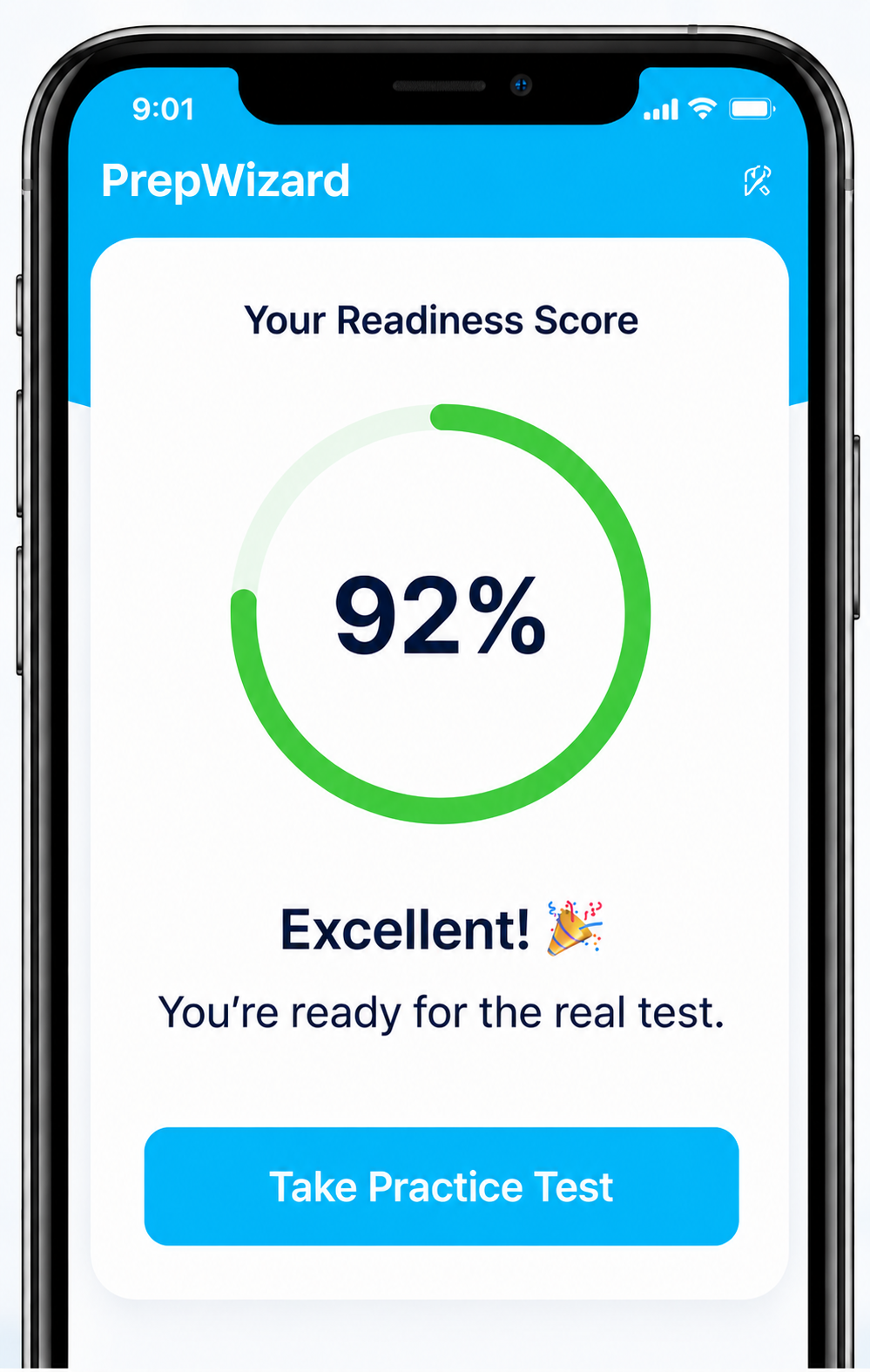 Sample readiness screen
Choose an answer to continue.
Questions about your course? Call 1-800-482-6593.
Choose your county or area to find local driver education information and links to its cities and communities.
Place names and county relationships: 2020 U.S. Census reference files. Includes county equivalents and census-designated communities.