
Build your driving foundation.
Start the self-paced online course on any device and learn Kansas driving rules, hazard recognition, and defensive driving habits before you get behind the wheel.

ONLINE TEEN DRIVER EDUCATION
FLEXIBLE ONLINE DRIVER EDUCATION
FOR NEW DRIVERS IN KANSAS.

Take the course on any device. Your progress is saved automatically.
Start the self-paced online course on any device and learn Kansas driving rules, hazard recognition, and defensive driving habits before you get behind the wheel.
Use your included 3-day PrepWizard trial to work through Kansas-specific practice questions, timed test simulations, and Focus Mode sessions targeting the topics you miss most.
Pass the written and vision requirements for your instruction permit at 14, then complete your supervised driving hours and Kansas licensing requirements as you work toward restricted and less-restricted driving privileges.
Choose the course that fits your Kansas learning goals.
Compare approval, the total cost, and the help you’ll get along the way.
Review current Kansas options and prices.
Ask what’s included before you enroll.
Take the next step toward confident driving in Kansas.
Find your course and start building good habits.
Review your course details and price before you enroll.

Short study sessions that fit around school and family life.
Pick up where you left off, on your own schedule.
Review your course and completion details before you enroll.
Our team can help with course, account, and certificate questions.
Quick answers for Kansas teens and parents.
Find more help on our full FAQ page.
You can begin with an instruction permit at 14, qualify for a restricted license at 15 through the approved pathway, receive less-restricted privileges at 16, and qualify for a non-restricted license at 17.
Approved driver education is required if you want the age-15 restricted license. It is not required for the age-16 less-restricted pathway, although completing an approved course can provide testing benefits.
It should not be treated as an approved Kansas driver education course unless the specific course has current Kansas approval. Use an approved Kansas program when you need driver education to satisfy a licensing requirement.
No. Kansas requires the instruction permit used for this requirement to have been issued by the driver licensing office; time on a driver education DE-99 permit does not count toward the one-year period.
The age-15 restricted-license pathway requires at least 25 hours before the restricted license. You must then complete 25 additional hours, including at least 10 nighttime hours, for a total of 50 hours before moving to the less-restricted stage at 16.
A licensed adult at least 21 years old must occupy the front seat beside you while you drive with an instruction permit.
Driving is generally limited to qualifying work, school, religious activities, or trips with a qualifying adult. A 15-year-old restricted-license holder may not transport non-sibling minor passengers.
Yes, but only for the specific purposes allowed by the restricted license, such as qualifying work, school, or religious activities. Other driving generally requires a qualifying adult supervisor.
At 16, you can move to less-restricted privileges after satisfying the applicable requirements, including the 50-hour supervised-driving affidavit and maintaining the required driving record.
With the less-restricted privileges, you can generally drive alone from 5:00 a.m. to 9:00 p.m. Additional trips for work, authorized school activities, and qualifying religious activities are permitted, and a qualifying adult can accompany you at other times.
During the applicable six-month restriction period, you may have no more than one non-sibling passenger under 18.
No. Wireless communication device use is prohibited for these young-driver stages except for limited emergency-related purposes.
It is a special permit for eligible teens ages 14 through 16 who live or work on a qualifying farm. It allows limited driving connected with farm work and school under separate restrictions.
A qualifying driver education completion certificate can be accepted in place of certain written and driving examinations at the applicable licensing stages. The Kansas Division of Vehicles should determine whether your specific certificate qualifies.
You can qualify for a non-restricted license at 17 after completing the applicable graduated-driver requirements. Once issued, the GDL restrictions no longer apply.
Licensing information: Kansas Division of Vehicles →
Find your next step, or get help from our team.
Kansas uses a graduated licensing system that gives young drivers more independence as they gain experience. You can begin with an instruction permit at 14, qualify for a restricted license at 15 if you complete approved driver education, receive less-restricted privileges at 16 after meeting the applicable requirements, and obtain a non-restricted license at 17.
Kansas-approved driver education can make a meaningful difference in this process. An approved course is required for the age-15 restricted license, and a qualifying driver education completion certificate can be used in place of certain written and driving tests at later licensing stages. TeenDrivingCourse is a supplemental online learning resource and should not be presented as a Kansas-approved driver education course unless the specific course has current Kansas approval.
At 14, you can apply for a Kansas instruction permit. Applicants ages 14 and 15 need written approval from a parent or guardian. You must meet the state's identification requirements and pass the required vision and written testing, unless you qualify to use a driver education completion certificate in place of the written test.
When you're driving with an instruction permit, a qualified licensed adult at least 21 years old must occupy the front seat beside you. The Kansas permit is generally held for one year before you can advance to the age-15 restricted-license stage.
One important detail: time spent using a driver education program's temporary DE-99 permit does not count toward the one-year Kansas-issued instruction-permit requirement. If reaching the restricted-license stage at 15 is your goal, the state-issued permit needs to satisfy that one-year period.
Kansas requires supervised practice before you can move through the graduated licensing stages. To receive the age-15 restricted license, you must have held a Kansas-issued instruction permit for at least one year, completed an approved driver education course, and completed at least 25 hours of adult-supervised driving.
The restricted license is designed for limited-purpose driving. At 15, you can generally drive to and from work or farm-related employment, directly to and from school on days school is in session, directly to and from qualifying religious activities, or at other times when accompanied by a qualifying licensed adult.
A 15-year-old restricted-license holder cannot transport non-sibling minor passengers. Wireless communication devices are also prohibited while driving, except for limited emergency-related purposes.
Kansas specifically requires approved driver education for the age-15 restricted license. An approved driver education completion certificate may also allow you to substitute for written and driving testing at later stages.
TeenDrivingCourse does not replace that requirement unless the specific course is confirmed as Kansas-approved. Use an approved Kansas program when you need driver education to satisfy a licensing requirement.
Before moving into the less-restricted stage at 16, you need a parent- or guardian-signed affidavit showing that you completed at least 50 hours of supervised driving, including at least 10 hours at night. The supervised driving must be completed with a qualifying adult who is at least 21 years old.
At 16, you can receive less-restricted privileges when the required affidavit has been submitted and you maintain the required driving record. If the 50-hour affidavit is not provided, the more restrictive conditions continue until age 17.
At this stage, you can generally drive from 5:00 a.m. to 9:00 p.m., drive to or from work, attend authorized school activities, and travel directly to or from qualifying religious activities. You may also drive at other times when accompanied by a qualifying licensed adult.
For the first six months of the age-16 restricted period, you are limited to one non-sibling passenger under 18.
At 17, you can qualify for a non-restricted Kansas driver's license after completing the applicable graduated-license requirements. A 17-year-old who is moving through the GDL system must provide the required 50-hour affidavit; once the non-restricted license is issued, the GDL driving and passenger restrictions no longer apply.
Kansas can also delay progression when a young driver accumulates qualifying moving violations. Keeping a clean record is an important part of moving from one stage to the next.
Kansas's graduated system can be summarized like this:
Kansas also has a special farm permit for eligible teens ages 14 through 16 who live or work on a qualifying farm. Under Kansas law, a farm is generally defined as a parcel larger than 20 acres used for agricultural operations.
Farm permits allow qualifying young drivers to make specific trips connected with farm work and school. They have their own testing, passenger, supervised-driving, and restriction requirements, so families using this pathway should check current eligibility with the Kansas Division of Vehicles.
Kansas prohibits instruction permit and restricted-license holders from operating wireless communication devices while driving, except for limited purposes such as reporting illegal activity or summoning emergency assistance.
For a new driver, the safest habit is straightforward: keep your phone out of reach and wait until the vehicle is parked before using it.
Kansas requires drivers and passengers to comply with the state's safety-belt requirements. Young drivers should make buckling up automatic before the vehicle moves.
Kansas requires automobile insurance, including liability coverage and personal injury protection. Current minimum liability limits are:
Kansas also requires Personal Injury Protection (PIP) coverage. The Kansas Department of Insurance lists minimum PIP benefits that include medical expenses, disability or loss-of-income benefits, substitution benefits, funeral expenses, and rehabilitation expenses.
These are minimum legal requirements. Families may choose higher coverage depending on their needs.
The Kansas written test is based on information in the Kansas Driving Handbook and covers areas such as traffic laws, safe driving practices, and road signs. Preparing with practice questions can help you become comfortable applying what you studied before taking the actual test.
Use PrepWizard to practice for your Kansas knowledge test and identify topics to review in the driver handbook. Check the current practice options, access, and trial terms before you begin.
With PrepWizard, you can:
Use the trial strategically around your test date so you can identify weak areas before visiting the driver's license office.
Kansas-approved driver education has specific licensing benefits. It is required for the age-15 restricted license, and an approved driver's education completion certificate can substitute for certain state testing requirements.
TeenDrivingCourse should therefore be presented as a supplemental learning and preparation resource, not as a replacement for an approved Kansas driver education course.
You can use the course to strengthen your understanding of right-of-way rules, following distances, hazard recognition, defensive driving, and other safe-driving concepts before and during your supervised practice.
The goal is to make your supervised driving time more productive: instead of learning every concept for the first time behind the wheel, you can arrive with a stronger foundation and spend more time applying what you know.
Build confidence one question at a time. Try a few practice questions, then keep preparing for your Kansas knowledge test.
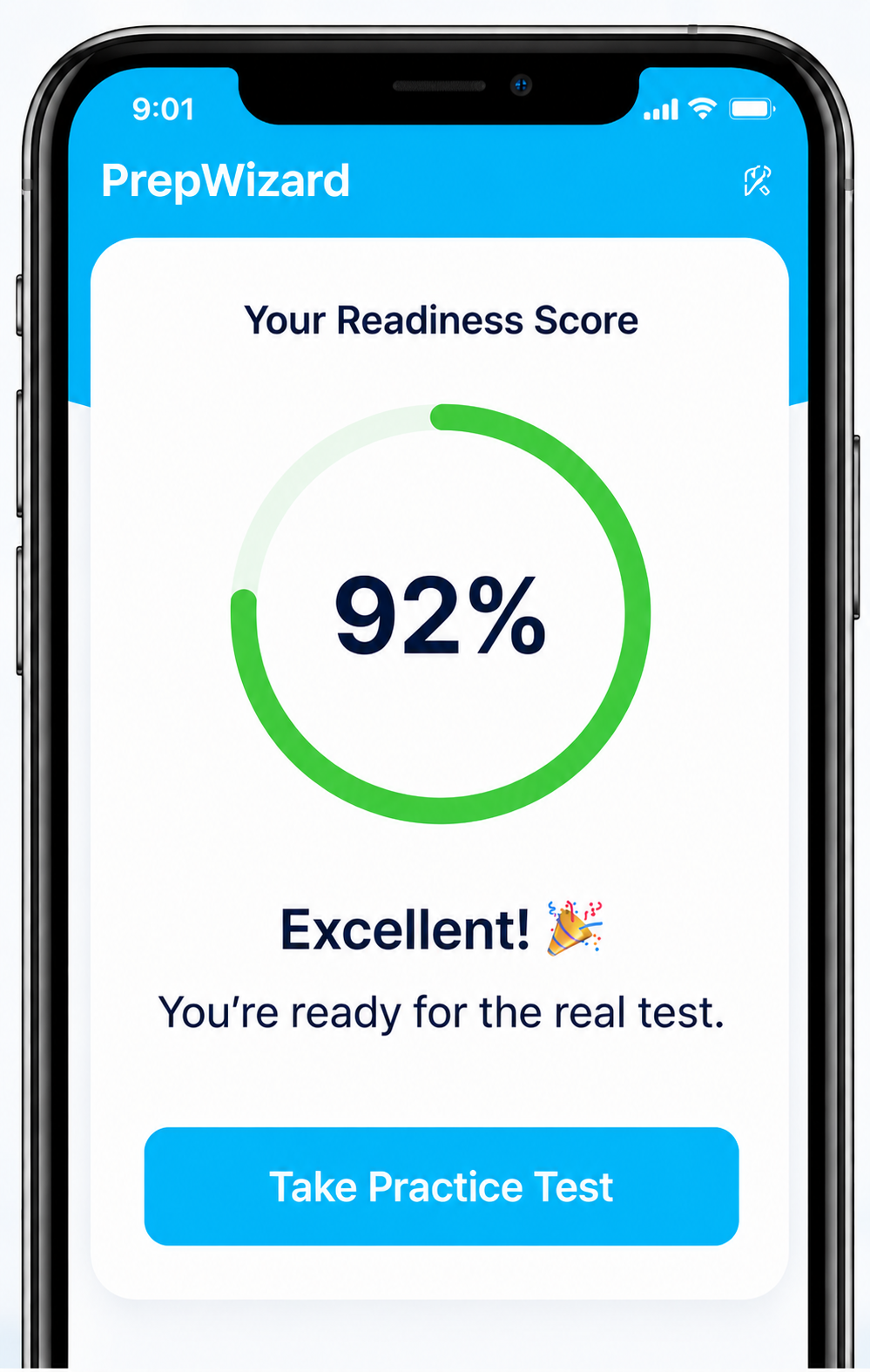 Sample readiness screen
Choose an answer to continue.
Questions about your course? Call 1-800-482-6593.
Choose your county or area to find local driver education information and links to its cities and communities.
Place names and county relationships: 2020 U.S. Census reference files. Includes county equivalents and census-designated communities.