Maine Online Driver Education
Getting a Driver's License in Maine: The Basics
Maine allows a person age 15 or older to apply for a learner's permit, but applicants who are under 18 must complete an approved driver education course before applying. To qualify for a driver's license at 16 or 17, a young driver must have completed approved driver education, held the learner's permit for at least six months, completed at least 70 hours of supervised driving including 10 hours at night, and passed the road test.
That makes Maine's process different from states where teens can simply get a permit and start practicing. For anyone under 18, the approved driver education course comes first. A driver education completion certificate is part of the learner's permit application requirements.
Here's something important to know before you enroll: TeenDrivingCourse is not a BMV-approved Maine driver education course. It does not replace the approved driver education program or provide the completion certificate required for an under-18 learner's permit. Instead, it can serve as a supplemental preparation tool to help you review traffic laws, defensive driving concepts, and safe-driving habits before and during your official licensing process.
Here's the road ahead at a glance:
- Learner's permit: available at 15 or older; applicants under 18 must complete approved driver education before applying and must pass the required examination.
- Road-test eligibility: applicants under 21 must generally hold the permit for at least six months and complete 70 hours of supervised driving, including 10 hours after dark.
- Intermediate license: a license issued to someone under 18 carries intermediate restrictions for 270 days.
- Unrestricted license: after the 270-day intermediate period, the restrictions end, but the initial license remains provisional for two years.
How Maine's Graduated Licensing System Works
Step 1: Complete Approved Driver Education, Then Get Your Permit
Maine requires drivers between 15 and 17 who want to begin the licensing process to complete an approved driver education course before applying for a learner's permit. The BMV maintains a list of approved driver education schools, and Maine law requires the completion of driver education before a person under 18 may apply for a permit.
The learner's permit application requires, among other items, the driver education completion certificate for applicants under 18. Once your application is processed, you complete the required examination, including the written test and vision screening.
To be completely clear: TeenDrivingCourse is not a BMV-approved Maine driver education course. Its online course cannot substitute for Maine's required approved driver education or generate the official completion certificate. You can, however, use it as an extra study resource before your approved course and throughout your preparation.
Step 2: Log Your 70 Hours
Maine requires applicants under 21 to complete at least 70 hours of supervised driving, including 10 hours of night driving, before applying for the road test. Those hours must begin after the learner's permit is issued.
Your supervising driver must generally be at least 20 years old and have held a valid driver's license for at least two years. Maine allows the required driving time to be certified by a parent, stepparent, guardian, spouse, or employer, as applicable.
The learner's permit itself is valid for two years. If it expires, you must apply for a new permit and retake the required examination, although previously logged driving hours can carry over and there is no additional six-month wait before applying for the road test.
Maine also prohibits permit holders from using a cellular phone while operating a vehicle.
Step 3: Pass Your Road Test and Move to an Intermediate License
Once you are eligible, you can apply for the road test. For applicants under 21, that generally means holding the learner's permit for at least six months, completing the required 70 hours including 10 hours at night, and successfully completing the road test.
A driver's license issued to someone under 18 is an intermediate license. You may drive without a supervising adult, but the intermediate license comes with specific restrictions for the first 270 days.
Step 4: Complete the 270-Day Intermediate Period
The intermediate restrictions remain in effect for 270 days from the original issue date. After that period, the special intermediate restrictions end unless they have been extended because of a violation.
But the end of the 270-day period does not mean the driver is completely outside Maine's provisional system. A driver's license is considered provisional for two years following initial issuance, and a conviction for a moving violation during that period results in license suspension.
Maine Teen Driving Laws You Should Know
Intermediate License Restrictions
For the first 270 days after receiving an intermediate license, Maine imposes three major restrictions:
- Passengers: no passengers other than immediate family members unless accompanied by a qualifying supervising driver.
- Curfew: no driving between 12:00 a.m. and 5:00 a.m.
- Devices: no operating a vehicle while using a mobile telephone.
Violating an intermediate-license restriction can lead to a suspension, and the restriction period can be extended for another 270 days from the violation.
The Provisional Period Has Real Consequences
Maine's intermediate restrictions last 270 days, but the provisional period lasts longer. During the first two years after the initial license is issued, a conviction for a moving violation can result in license suspension.
For a young driver, that means completing the 270-day restriction period is only one milestone. Safe driving habits still matter throughout the entire provisional period.
The Phone Rules
Maine prohibits learner's permit holders from using a cellular phone while driving. Intermediate-license holders are also prohibited from operating a vehicle while using a mobile telephone. Maine law specifically includes interacting with a mobile telephone or handheld electronic device while the vehicle is temporarily stopped in traffic.
The safest approach is simple: keep your phone out of reach until the vehicle is safely parked.
Maine Insurance Requirements
Maine requires minimum financial responsibility coverage for vehicles operated on the state's roads. The minimum liability limits are:
- $50,000 for bodily injury to one person
- $100,000 for bodily injury to more than one person in one accident
- $25,000 for property damage
Maine also requires at least $2,000 in medical payments coverage and $50,000/$100,000 in uninsured/underinsured motorist coverage.
These are legal minimums rather than recommended coverage levels. Maine's insurance regulators note that minimum limits may not be enough to fully protect a family from the financial consequences of a serious crash.
Prepare for Your Maine Written Test with PrepWizard
The Maine written examination is part of the licensing process, and the state's official study materials include the Maine Driver's License Manual and Motorist Handbook and Study Guide. The BMV provides these materials for applicants preparing for the examination.
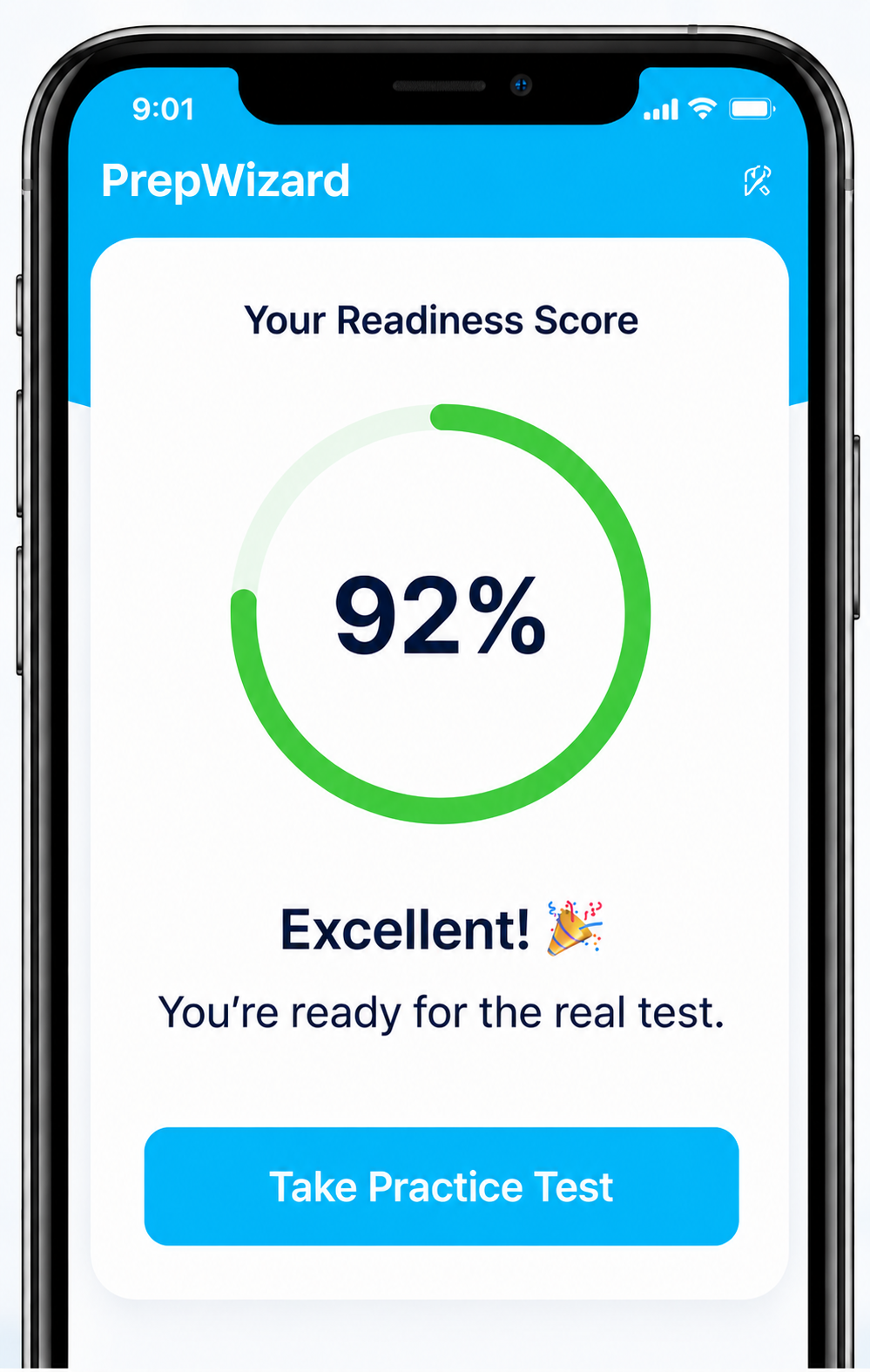
Use PrepWizard to turn reading into active practice before your knowledge test. Review the current access and trial terms when choosing your practice option.
With PrepWizard, you can:
- Practice questions covering Maine traffic rules, safe-driving concepts, and road signs
- Take timed practice exams to become comfortable answering questions under pressure
- Use Focus Mode to concentrate on subjects you repeatedly miss
- Track your practice performance as you study
- Practice from a computer, tablet, or smartphone
The goal is to supplement—not replace—Maine's official driver education and licensing process. Use the official Maine materials for the rules that govern your examination, then use practice testing to reinforce what you have learned.
Where TeenDrivingCourse Fits in Maine
The most important point is straightforward: TeenDrivingCourse is not a BMV-approved Maine driver education course. For applicants under 18, it does not replace the approved driver education requirement and does not provide the completion certificate needed for the learner's permit application.
So where does it fit? As a supplemental study resource.
You can use the self-paced course to review defensive driving techniques, hazard recognition, right-of-way concepts, traffic laws, and safe-driving habits before starting your approved Maine driver education course. You can also use the included 3-day PrepWizard trial to practice before the written examination.
Once you receive your permit, the focus shifts from studying to experience. Maine requires 70 hours of supervised driving, including 10 hours at night, before the road test for applicants under 21. Preparation can give you a stronger foundation, but those supervised hours are where you develop the judgment and habits that matter on the road.
Think of it this way: Maine requires the approved course. TeenDrivingCourse helps you arrive prepared.




 Sample readiness screen