Maryland Online Driver Education
Getting a Driver's License in Maryland: The Basics
Maryland's graduated licensing system is known as the Rookie Driver Program. A young driver can apply for a learner's permit at 15 years and 9 months, and a provisional license can follow after the required permit period, driver education, supervised practice, and driving test. A full driver's license becomes available once the provisional requirements are satisfied.
Maryland also has an important requirement that applies beyond teenagers: new drivers must complete a Maryland MVA-approved Driver's Education Course consisting of at least 30 hours of classroom instruction and 6 hours of behind-the-wheel training. The driving school electronically verifies completion with the MVA.
That means choosing an online supplemental course does not replace Maryland's certified program. TeenDrivingCourse is not an MVA-certified Maryland driver education provider. It does not satisfy Maryland's required driver education course or provide the official completion verification submitted by a certified school.
Instead, TeenDrivingCourse can be used as an additional preparation resource. You can study traffic laws, defensive driving concepts, hazard awareness, and road rules before starting your required Maryland program and continue reviewing while you practice behind the wheel.
Here's the road ahead at a glance:
- Learner's permit: available beginning at age 15 years and 9 months, after meeting Maryland's application, testing, and parental-consent requirements when applicable.
- Provisional license: available after meeting the required permit-holding period, completing certified driver education, completing the required supervised practice hours, remaining free of qualifying recent moving violations, and passing the driving skills test.
- Full license: available at age 18 after holding the provisional license for at least 18 months without a conviction or probation before judgment for a moving violation during that period.
How Maryland's Rookie Driver Program Works
Step 1: Get Your Learner's Permit at 15 Years and 9 Months
Maryland allows a person to apply for a learner's permit beginning at 15 years and 9 months. At the MVA appointment, applicants complete a vision screening and knowledge test. Once the permit is issued, the new driver may begin supervised practice and, where applicable, behind-the-wheel driver education.
Applicants under 18 need a parent, guardian, or co-signer to provide the required approval. Maryland also has additional documentation requirements for younger applicants, so it's important to check the MVA's current application requirements before your appointment.
With a learner's permit, you may not drive alone. You must be accompanied by a qualified supervising driver who is at least 21 years old and has held a driver's license for at least three years, seated in the front passenger seat.
The MVA also prohibits learner's permit holders from using a cell phone while driving, including hands-free use, except for a 911 emergency call.
And to be completely clear: TeenDrivingCourse is not an MVA-certified Maryland driver education course. It cannot substitute for the certified program or its official completion verification.
Step 2: Complete MVA-Certified Driver Education
Maryland requires new drivers to complete an MVA-approved driver education course consisting of at least 30 classroom hours and 6 hours of behind-the-wheel instruction. Your certified driving school electronically submits verification of completion to the MVA.
The learner's permit must be in hand before the behind-the-wheel portion of the driver education course begins. When you later apply for a provisional license, the MVA requires the completed driver education verification along with the required practice documentation.
TeenDrivingCourse does not replace this requirement. Its role is supplemental: use it to build familiarity with traffic laws, defensive driving principles, and safe-driving concepts before and during your official Maryland program.
Step 3: Log Your Supervised Practice Hours
For drivers under 25, Maryland generally requires 60 hours of supervised practice driving, including at least 10 hours at night, before the provisional license. Maryland defines nighttime practice as beginning 30 minutes before sunset and continuing until 30 minutes after sunrise. The practice must be documented in the required skills practice log.
Your supervising driver must meet Maryland's qualifications, and the practice log becomes part of the documentation needed for the provisional-license process.
Maryland also pays close attention to your driving record during the permit period. A conviction or probation before judgment for a moving violation can delay your eligibility for the provisional license.
Step 4: Earn Your Provisional License and Work Toward Full Status
Once you've met Maryland's eligibility requirements, including the appropriate permit-holding period, certified driver education, supervised practice requirements, clean recent driving record, and successful completion of the driving skills test, you can receive a provisional license.
For drivers under 18, the provisional license carries specific restrictions involving passengers, nighttime driving, wireless devices, seat belts, and alcohol.
The provisional period lasts at least 18 months before a full license can be issued. To qualify for full status, you must be at least 18 and have no conviction or probation before judgment for a moving violation during the preceding 18 months. The MVA then automatically converts the provisional license to full status.
Maryland Teen Driving Laws You Should Know
Provisional License Restrictions
For provisional drivers under 18, Maryland's Rookie Driver rules include:
- Passengers: During the first 151 days, you generally may not drive with passengers under 18 unless they are immediate family members or a qualified supervising driver is present.
- Nighttime driving: You may not drive unsupervised between midnight and 5:00 a.m. unless a qualifying exception applies, such as traveling to or from work, an official school activity, an organized volunteer program, or an athletic event or related training.
- Wireless devices: You may not use a wireless communication device while driving, including hands-free use.
- Seat belts: All occupants must comply with Maryland's seat-belt requirements.
- Alcohol: Drivers under 21 are subject to Maryland's zero-tolerance alcohol restriction.
In plain terms: limit the passengers, respect the nighttime rules, and keep the phone completely out of use while driving.
The 18-Month Provisional Period
Maryland treats the provisional period as more than a waiting period. To move from provisional status to a full license, you must hold the provisional license for at least 18 months and have no conviction or probation before judgment for a moving violation during that period.
A moving violation while holding a provisional license can also trigger driver-improvement requirements, suspension, or other sanctions depending on the offense and the driver's age and record. A conviction or PBJ can restart the required 18-month conviction-free period.
The Phone Rules
Maryland prohibits learner's permit holders and provisional license holders from using a wireless communication device while driving, including hands-free devices. The exception for a learner's permit holder is a 911 emergency call.
The safest habit is simple: keep your phone out of reach until the vehicle is parked.
Maryland Insurance Requirements
A vehicle registered in Maryland must have the required minimum liability insurance. Maryland currently requires at least:
- $30,000 for bodily injury per person
- $60,000 for bodily injury per accident
- $15,000 for property damage
Maryland also requires uninsured motorist coverage at minimum limits specified by state law.
These are legal minimums, not necessarily the level of coverage a family should choose for a new teen driver. Review the family's policy with your insurer before adding a new driver.
Pass Your Maryland Knowledge Test With PrepWizard
The Maryland knowledge test covers areas including traffic laws, safe-driving practices, following distances, turn and lane-use rules, weather conditions, intersections, and the effects of alcohol and drugs on driving. The MVA itself recommends studying the Maryland driver's manual and offers practice tests because preparation can make the test format more familiar.
Use PrepWizard to turn reading into active practice before your knowledge test. Review the current access and trial terms when choosing your practice option.
With PrepWizard, you can:
- Practice questions covering Maryland traffic rules, safe-driving concepts, and road signs
- Take timed practice exams to get comfortable working under time pressure
- Use Focus Mode to concentrate on subjects you repeatedly miss
- Track your practice performance as you study
- Study from a computer, tablet, or smartphone
The MVA's own practice tutorial uses 25-question tests and offers a timed version designed to be completed within 20 minutes, giving you a useful benchmark for the type of testing experience Maryland applicants can expect.
The goal is to supplement your official preparation—not replace Maryland's licensing process.
Where TeenDrivingCourse Fits in Maryland
Let's make the distinction clear: TeenDrivingCourse is not an MVA-certified Maryland driver education provider. It does not satisfy Maryland's required certified driver education course, and it does not replace the official electronic completion verification submitted by a certified driving school.
So where does it help?
As a supplemental study resource. You can use the self-paced course to review traffic laws, hazard recognition, right-of-way, defensive driving, and safe-driving habits before beginning your certified Maryland driver education course.
The included 3-day PrepWizard trial can also help you practice for the Maryland knowledge test before your MVA appointment. The MVA itself recommends practice testing as a way to become familiar with the types of questions you'll encounter.
After you receive your permit, your focus shifts to supervised experience. For drivers under 25, Maryland generally requires 60 hours of supervised practice, including 10 nighttime hours, before the provisional license.
Think of it this way: Maryland requires the certified course. TeenDrivingCourse helps you arrive prepared.



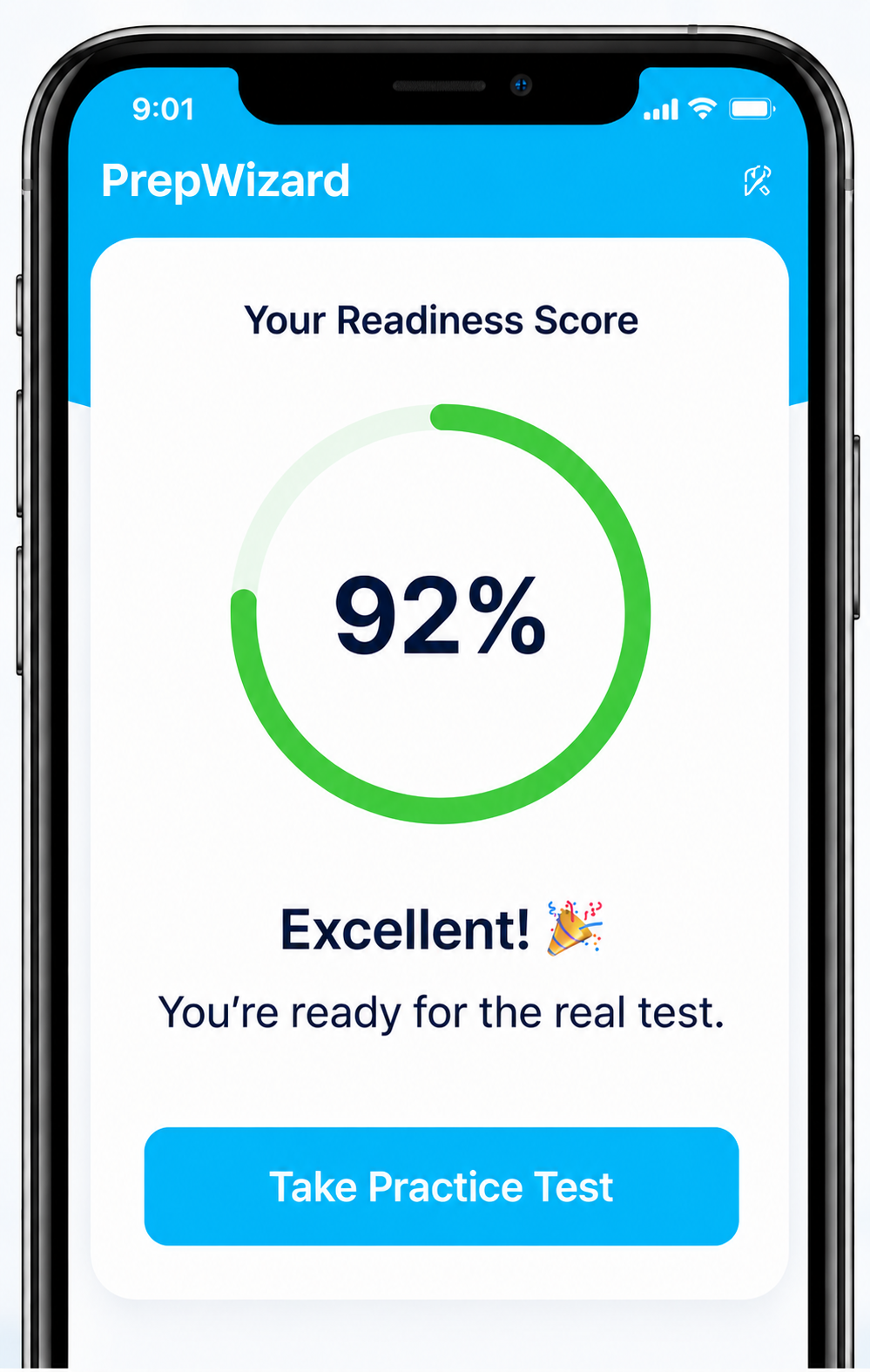 Sample readiness screen