Massachusetts Online Driver Education
Getting a Driver's License in Massachusetts: The Basics
Massachusetts allows you to apply for a Class D learner's permit at 16. A teen under 18 who wants to move on to a driver's license must complete the state's approved driver education program, hold a learner's permit for at least six consecutive months with a clean driving record, complete the required supervised driving, and pass the road test.
Massachusetts calls the teen licensing rules the Junior Operator License (JOL) system. For applicants under 18, the required driver education program consists of 30 hours of classroom instruction plus 18 hours of on-road instruction, including at least 12 hours of behind-the-wheel driving and 6 hours observing another student driver. A parent or guardian must also complete two hours of instruction unless they completed the parent class within the previous five years.
Here's something worth knowing up front: TeenDrivingCourse is not an RMV-licensed Massachusetts driver education program. It does not replace the required professional driver education program, its classroom or on-road components, or the official driver education certificate recorded with the RMV.
Instead, TeenDrivingCourse can be used as a supplemental preparation resource. You can review traffic laws, safe-driving concepts, hazard recognition, and defensive driving before your official Massachusetts program begins, while using PrepWizard to practice for the RMV permit exam.
Here's the road ahead at a glance:
- Learner's permit: age 16, after meeting the application requirements and passing the vision screening and 25-question learner's permit exam. Applicants under 18 need the required written consent.
- Junior Operator License: generally available beginning at 16½ after holding the permit for at least six consecutive months, maintaining a clean record, completing approved driver education, completing at least 40 additional supervised driving hours, and passing the road test.
- Full license: Junior Operator restrictions end at 18, although violations committed while a junior operator can carry mandatory suspension consequences.
How the Massachusetts Licensing Process Works
Step 1: Get Your Learner's Permit at 16
You must be at least 16 years old to apply for a Massachusetts Class D learner's permit. If you are under 18, you need written consent from a parent, legal guardian, or another legally authorized person.
The learner's permit exam contains 25 questions, and you have 25 minutes to complete it. You need at least 18 correct answers to pass. The exam covers subjects including rules of the road, impaired driving, the Junior Operator Law, and sharing the road with pedestrians, bicyclists, and visually impaired people.
Once you have your permit, you can begin supervised driving. The supervising driver must be properly licensed, at least 21 years old, have at least one year of driving experience, and occupy the seat beside you.
A permit holder under 18 also cannot drive between midnight and 5:00 a.m. unless accompanied by a parent or legal guardian who meets the state's requirements. Your learner's permit is valid for two years.
Step 2: Complete Licensed Professional Driver Education
Massachusetts requires applicants under 18 to complete an approved driver education program before taking the road test.
The program includes:
- 30 hours of classroom instruction
- 12 hours of behind-the-wheel instruction
- 6 hours of observation of another student driver
- 2 hours of parent or guardian instruction, unless the parent or guardian completed the required class within the previous five years.
A person can enroll in Massachusetts driver education beginning at 15 years and 9 months, but the on-road portion requires a valid learner's permit and the student must be at least 16.
When the program requirements have been completed, the driver education certificate is electronically filed with the RMV. Professional driving schools are responsible for notifying the RMV of completion.
To be completely clear: TeenDrivingCourse is not an RMV-licensed Massachusetts driver education program. It cannot substitute for the required classroom instruction, behind-the-wheel training, observation hours, parent class, or official driver education certificate.
Its role is supplemental. Use it to familiarize yourself with the concepts you'll encounter in your approved program and to strengthen your preparation for the RMV permit test.
Step 3: Log Your 40 Hours of Supervised Driving
For a teen seeking a Junior Operator License, Massachusetts requires at least 40 additional hours of supervised driving, documented through a certified statement from a parent or guardian. The RMV can accept 30 supervised hours instead when the applicant has successfully completed an approved driver skills development program.
These supervised hours are separate from the professional driver education program's 12 hours of behind-the-wheel instruction and 6 hours of observation.
You must also hold your learner's permit for at least six consecutive months and maintain a clean driving record for that period before taking the road test. A suspension invalidates the six-month period and causes the clock to begin again when the suspension ends.
The objective is not simply to accumulate hours. It is to gain enough supervised experience to handle everyday traffic, changing road conditions, and the decisions that come with driving independently.
Step 4: Pass Your Road Test and Become a Junior Operator
Once you are at least 16½, have held the learner's permit for the required six consecutive months, maintained a clean record, completed your approved driver education, and completed the required supervised driving, you can take the Class D road test.
When you take the road test, you need your learner's permit, the required application, a qualified sponsor, and an acceptable properly registered vehicle.
If you fail or miss the road test, Massachusetts requires you to wait at least 14 days before taking another one.
Pass, and you'll receive your Junior Operator License, subject to Massachusetts' restrictions until you turn 18.
Massachusetts Teen Driving Laws You Should Know
Junior Operator Restrictions
Massachusetts places significant restrictions on drivers under 18 holding a Junior Operator License:
- Passenger restriction: During the first six months, you generally cannot carry passengers under 18 other than siblings unless a qualified supervising driver is seated beside you.
- Night restriction: You generally cannot drive between 12:30 a.m. and 5:00 a.m. unless accompanied by a parent or guardian.
- Electronic devices: Drivers under 18 cannot use any mobile electronic device while operating a motor vehicle, including hands-free use, except for a permitted emergency call.
These restrictions are intended to reduce distractions and limit driving during higher-risk nighttime hours.
The Junior Operator Law Has Serious Penalties
Massachusetts treats Junior Operator violations seriously. Certain violations can result in mandatory license suspensions, reinstatement fees, retraining requirements, and other consequences.
For example, a first speeding offense while holding a JOL can result in a 90-day suspension. A first conviction for a mobile-electronic-device violation can result in a 60-day suspension, a fine, retraining, and other reinstatement requirements.
Passenger and nighttime restriction violations can also lead to mandatory suspension, and a suspension occurring during the six-month passenger-restriction period can extend that restriction period.
The takeaway is straightforward: your first months of independent driving are not the time to treat the rules casually.
The Phone Rules
Massachusetts' hands-free law generally prohibits drivers from holding or supporting an electronic device while driving. For drivers under 18, the rule is stricter: they cannot use any electronic device while operating a motor vehicle, including in hands-free mode. A limited exception exists for calling 911 in an emergency.
The safest habit is simple: keep the phone out of reach until the car is parked.
Massachusetts Insurance Requirements
Massachusetts requires four compulsory coverages for private passenger vehicles. The current minimum requirements include:
- $25,000 per person / $50,000 per accident for bodily injury to others
- $30,000 per accident for damage to someone else's property
- Up to $8,000 per person per accident in Personal Injury Protection
- $25,000 per person / $50,000 per accident for bodily injury caused by an uninsured automobile.
These minimums were updated effective July 1, 2025, so older Massachusetts insurance information may show lower limits.
Minimum legal coverage is not necessarily the same as the coverage a family will want after adding a new teen driver. Review the household policy and available coverage options with your insurer.
Pass Your Massachusetts Permit Test With PrepWizard
The Massachusetts Class D learner's permit exam contains 25 questions, and you need 18 correct answers to pass. You have 25 minutes to complete the test. The RMV directs applicants to study the Class D Driver's Manual because the exam covers Massachusetts motor vehicle laws and safe-driving practices.
Use PrepWizard to turn reading into active practice before your knowledge test. Review the current access and trial terms when choosing your practice option.
With PrepWizard, you can:
- Practice questions covering Massachusetts traffic laws, safe-driving concepts, and road rules
- Take timed practice exams so the testing format feels more familiar
- Use Focus Mode to work on topics you repeatedly miss
- Track your practice performance as you study
- Study from a computer, tablet, or smartphone
The RMV also provides its own permit-test practice resources, so use the official Massachusetts Driver's Manual as your primary source and use practice testing to reinforce what you learn.
Where TeenDrivingCourse Fits in Massachusetts
Let's make the distinction clear: TeenDrivingCourse is not an RMV-licensed Massachusetts driver education program. It does not satisfy the required 30 classroom hours, 12 hours of behind-the-wheel instruction, 6 observation hours, or parent/guardian instruction, and it does not generate the official driver education certificate that an approved school files with the RMV.
So where does it help?
As a supplemental preparation tool.
You can use the self-paced course to review traffic laws, right-of-way, hazard recognition, defensive driving, and other foundational concepts before beginning your Massachusetts-approved driver education program.
You can also use the included 3-day PrepWizard trial to practice for the 25-question learner's permit exam and become more comfortable answering questions under time pressure.
Once you have your learner's permit, the work becomes more practical. You need at least six consecutive months with a clean driving record and at least 40 additional hours of supervised driving before the road test, unless you qualify for the reduced-hour option through an approved driver skills development program.
Think of it this way: Massachusetts requires the licensed program. TeenDrivingCourse helps you arrive prepared.




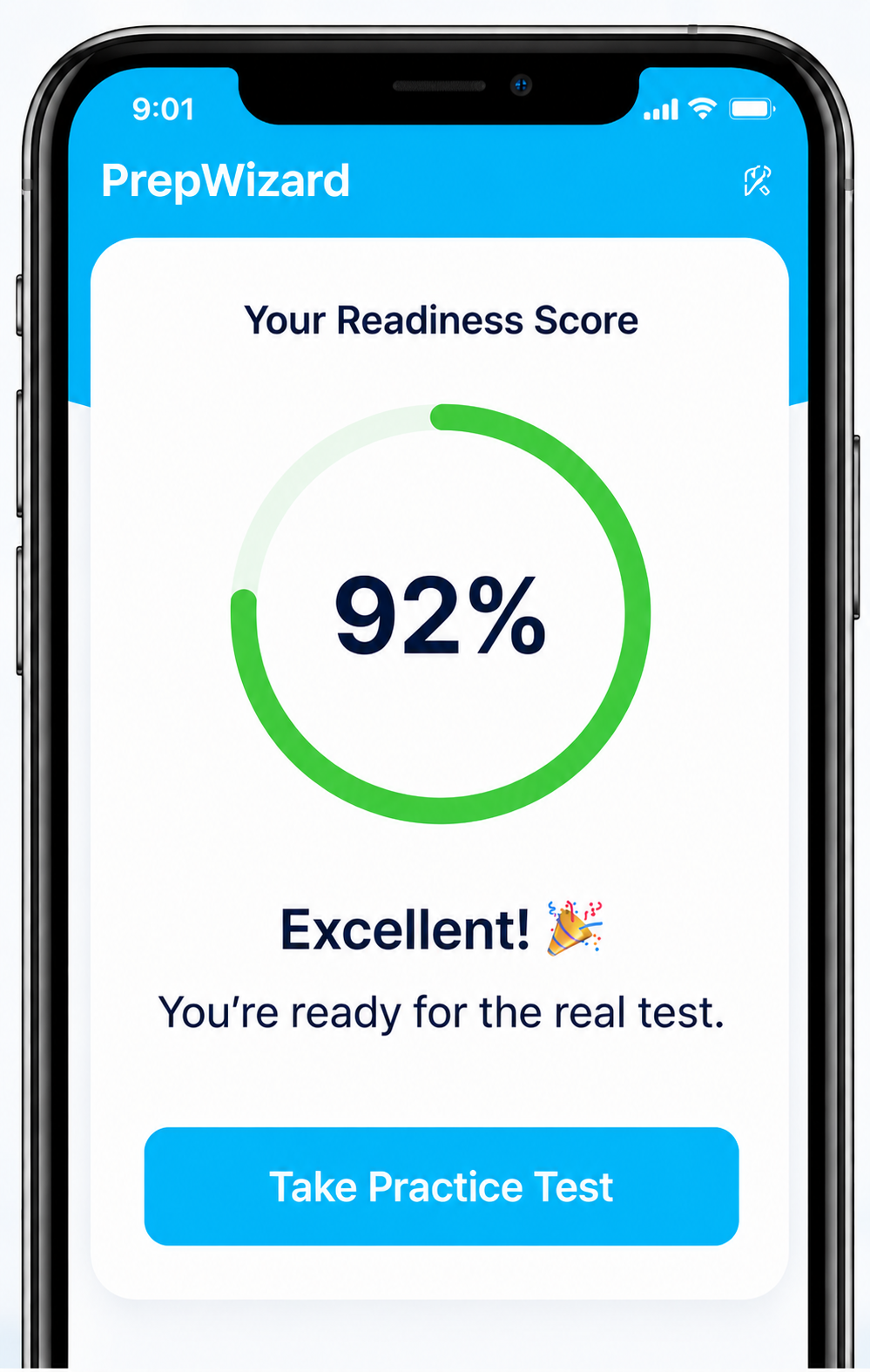 Sample readiness screen