
Enroll and build your driving foundation.
Start the self-paced online course on any device and learn the rules, hazard recognition, and defensive habits that city driving demands, before your knowledge test is even scheduled.

ONLINE TEEN DRIVER EDUCATION
FLEXIBLE ONLINE DRIVER EDUCATION
FOR NEW DRIVERS IN WASHINGTON DC.

Take the course on any device. Your progress is saved automatically.
Start the self-paced online course on any device and learn the rules, hazard recognition, and defensive habits that city driving demands, before your knowledge test is even scheduled.
Your course includes a 3-day PrepWizard trial with DC-specific practice exams, timed test simulation, and a Focus Mode that targets the topics you keep missing.
Pass the knowledge test for your learner permit at 16, then build real skills through six clean permit months and 40 supervised hours on the way to your provisional license at 16½.
Choose the course that fits your Washington DC learning goals.
Compare approval, the total cost, and the help you’ll get along the way.
Review current Washington DC options and prices.
Ask what’s included before you enroll.
Take the next step toward confident driving in Washington DC.
Find your course and start building good habits.
Review your course details and price before you enroll.

Short study sessions that fit around school and family life.
Pick up where you left off, on your own schedule.
Review your course and completion details before you enroll.
Our team can help with course, account, and certificate questions.
Quick answers for Washington DC teens and parents.
Find more help on our full FAQ page.
The provisional license comes at 16½, after a learner permit, available at 16, held six violation-free months. The full license with conditions arrives at 17, and the GRAD program's framework runs until 21.
No. The District requires the knowledge test, six clean permit months, 40 supervised hours, and the road skills test instead. No course is required at any stage.
No. Our course is not approved by the DC DMV, and the District has no course requirement. It's an optional study course for building knowledge and safe driving habits before and during the licensing process.
Forty supervised hours, logged on the DMV's certification form with a photocopy of the supervising driver's license attached, and completed alongside six violation-free permit months.
No, and DC's rule is unusual: even supervised, permit holders drive only between 6:00 a.m. and 9:00 p.m.
Solo driving runs 6:00 a.m. to 10:00 p.m. during the school year, and extends to midnight in July and August, the District's summer-hours twist.
You wait 72 hours to retake it, and a sixth failure means waiting a full year from the date of your first attempt. Arrive with a licensed adult 21 or older, too, or the DMV cancels the appointment.
The provisional license requires six months with no traffic violations, so a ticket, including camera enforcement, can push your timeline back. In the District, the clean record is the requirement.
Licensing information: DC Department of Motor Vehicles →
Find your next step, or get help from our team.
In the District of Columbia, teenagers can get a learner permit at 16, a provisional license at 16½, and a full license with conditions at 17, under a program with the most memorable name in American licensing: GRAD, the Gradual Rearing of Adult Drivers. The DC DMV runs it, and one number sets the District apart from every state: GRAD's framework runs until age 21, not 18.
Here's something worth knowing up front: the District requires no driver education course at any stage. TeenDrivingCourse's online course is not approved by the DC DMV and doesn't count toward any District licensing requirement, because there's no course requirement for it to count toward. What DC requires instead is a knowledge test, six violation-free permit months, and 40 hours of supervised practice logged by your family. Our course prepares you for the first and builds the foundation for the last, and in a city where a new driver's first miles include traffic circles, bus lanes, bike lanes, and diagonal avenues crossing the grid, foundation is not a luxury. This page walks you through exactly how the GRAD program works, and shows you where our study tools help along the way.
Here's the road ahead at a glance:
At 16, you can apply at a DC DMV service center with your identity and residency documents and, for 16 and 17 year olds, the signed Parental Consent Form. You'll pass a vision screening and the DMV knowledge test, drawn from the DC Driving Manual, with the test fee paid per attempt, one more reason to pass the first time. More on that below.
Permit rules are stricter than most states', starting with a rule almost nobody expects: even supervised, learner permit holders may drive only between 6:00 a.m. and 9:00 p.m. Your supervising driver is a licensed adult 21 or older, and the phone rule for permit holders is total: no device use behind the wheel, at all. A permit never allows driving alone.
Provisional eligibility takes three things: reaching 16½, holding the permit six months with no traffic violations, not points, any violation, and 40 hours of supervised practice logged on the DMV's certification form. One paperwork detail that catches families at the counter: the form must be accompanied by a photocopy of the supervising driver's license. Log as you go, and treat the 40 hours as the training they're designed to be: circles, merges, alley crossings, rain, and the 6-to-9 evening window that passes for night practice under a permit.
Book the road skills test, and arrive with a licensed driver 21 or older, because showing up alone cancels the appointment. Pass, and the provisional license is yours on the spot. Miss, and the DMV's retry ladder is specific: 72 hours before a retake, and six failures means waiting a full year from the first attempt. Preparation is cheaper than the ladder.
The provisional license means driving alone, within GRAD's hours: 6:00 a.m. to 10:00 p.m. through the school year, and here's the District's charming seasonal twist, extended to midnight in July and August. Summer in DC comes with later keys.
At 17, provisional drivers in good standing move to the full license with conditions, with passenger and hour conditions continuing to phase out, and at 21, the GRAD framework releases you entirely. That's the District's design: a late start by national standards, a long runway by every standard, and city-tested drivers at the end of it.
The GRAD program meters driving hours at every phase:
Violations carry consequences beyond fines: they can delay or reset progress through the phases, and GRAD explicitly puts the burden of keeping the privilege on the young driver.
DC's permit phase doesn't run on points arithmetic, it runs on zero: six months with no traffic violations before the provisional license. In a city with camera enforcement on speed and red lights nearly everywhere, that standard is stricter than it sounds, and it's one more argument for building careful habits from the first supervised mile.
The District bans handheld phone use for all drivers, and for learner permit holders the ban is total: no device use while driving, period. The habit the law builds is the right one: the phone stays out of reach until the car is parked.
Every District driver must carry liability insurance plus uninsured motorist coverage. The current minimums are:
Review the family policy before a new teen driver joins it.
The DC knowledge test draws from the DC Driving Manual, covering traffic laws, road signs, and safe driving practices, with the test fee charged per attempt. Plenty of smart students fail on the first try for one simple reason: they read the manual but never practiced answering test-style questions under pressure.
PrepWizard, our online practice test platform, fixes that, and every course purchase includes a 3-day PrepWizard trial. With PrepWizard you can:
Three focused days of practice tests before your DMV visit can be the difference between passing on the first try and paying to come back for a second one. Time your trial for the week of your test, and walk in having already passed it in practice.
Let's answer the obvious question directly: no, our online driver education course is not approved by the DC DMV, and the District has no driver education requirement for it to fulfill.
So why take it? Because the GRAD program hands the entire education to you and your family: a knowledge test with a per-attempt fee, 40 supervised hours in one of the trickiest driving environments in the country, and a clean-record standard enforced by cameras on half the corners. Our course teaches defensive driving techniques, hazard recognition, right-of-way rules, and safe driving habits in a self-paced online format you can start before your DMV appointment is even booked. Families use it to pass the knowledge test the first time, and as a structured companion through the 40 hours, where the traffic circle at Dupont is on the syllabus whether anyone assigns it or not.
Think of it this way: the District hands you the test dates. We help you show up ready.
Build confidence one question at a time. Try a few practice questions, then keep preparing for your Washington DC knowledge test.
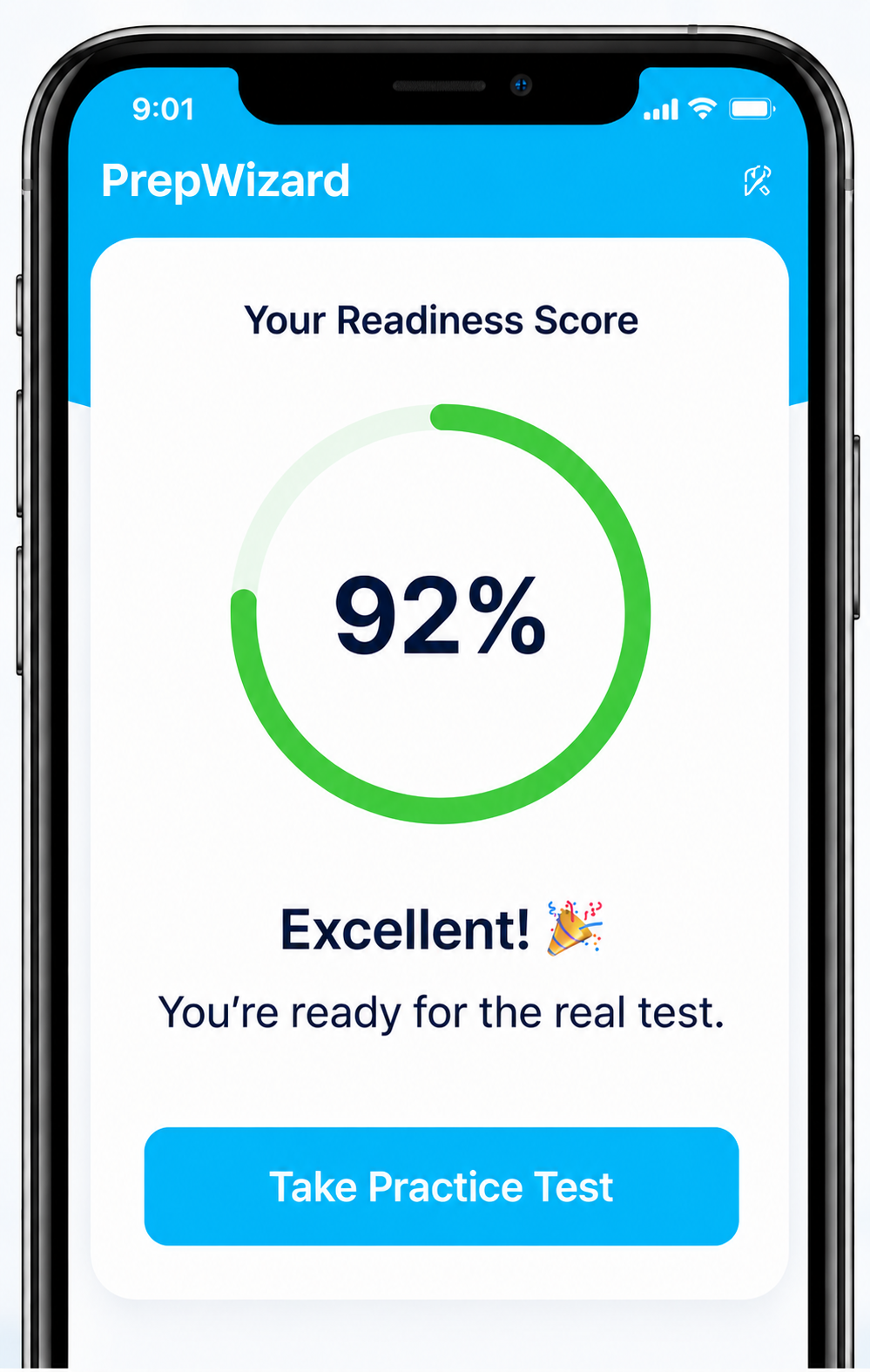 Sample readiness screen
Choose an answer to continue.
Questions about your course? Call 1-800-482-6593.
Choose your county or area to find local driver education information and links to its cities and communities.
Place names and county relationships: 2020 U.S. Census reference files. Includes county equivalents and census-designated communities.