
Build your driving foundation.
Start the self-paced Teendrivingcourse.com program on any device and review West Virginia traffic rules, hazard recognition, right-of-way, and defensive-driving habits before taking your permit test.

ONLINE TEEN DRIVER EDUCATION
FLEXIBLE ONLINE DRIVER EDUCATION
FOR NEW DRIVERS IN WEST VIRGINIA.

Take the course on any device. Your progress is saved automatically.
Start the self-paced Teendrivingcourse.com program on any device and review West Virginia traffic rules, hazard recognition, right-of-way, and defensive-driving habits before taking your permit test.
Use the included 3-day PrepWizard trial to work through West Virginia-specific practice questions, take timed practice exams, and focus on the topics you need to review most.
At 15, pass the required vision and knowledge tests and obtain your Level 1 Instruction Permit. Then complete the required 180 conviction-free days and either 50 hours of supervised driving, including 10 at night, or an approved driver education course before moving toward Level 2.
Choose the course that fits your West Virginia learning goals.
Compare approval, the total cost, and the help you’ll get along the way.
Review current West Virginia options and prices.
Ask what’s included before you enroll.
Take the next step toward confident driving in West Virginia.
Find your course and start building good habits.
Review your course details and price before you enroll.

Short study sessions that fit around school and family life.
Pick up where you left off, on your own schedule.
Review your course and completion details before you enroll.
Our team can help with course, account, and certificate questions.
Quick answers for West Virginia teens and parents.
Find more help on our full FAQ page.
You must be at least 15 years old and meet the Level 1 eligibility requirements, including the required written and vision examinations and other application requirements.
You must have held the Level 1 Instruction Permit for 180 consecutive days without a conviction during the 180 days immediately preceding your Level 2 application.
The standard experience path requires 50 hours of supervised driving, including at least 10 hours at night. An approved Department of Education driver education course can satisfy the experience requirement instead.
No. Teendrivingcourse.com is supplemental and does not substitute for the state-approved driver education course that can satisfy the Level 2 experience requirement.
A licensed driver who is at least 21 years old can supervise you, or a qualifying driver education or driving-school instructor acting officially as an instructor. The supervisor must be alert and unimpaired.
No. A Level 1 permit requires direct supervision by a qualified licensed driver or instructor whenever you drive.
A Level 1 permit holder may drive between 5 a.m. and 10 p.m. while supervised. The statutory permit conditions do not allow independent driving.
You must be at least 16, satisfy the 180-day conviction-free Level 1 period, complete either the approved driver education or 50-hour experience path, and pass the road skills examination.
You may generally drive unsupervised from 5 a.m. to 10 p.m. Between 10 p.m. and 5 a.m., a licensed driver age 21 or older must supervise unless a qualifying work, school, religious, or emergency exception applies.
During the first six months, passengers under 20 generally must be family members. During the second six months, you may carry no more than one passenger under 20 who is not a family member.
West Virginia requires the driver to enroll in an approved driver improvement program after the first conviction for a moving traffic violation or certain Level 2 violations, unless a greater penalty applies.
A second conviction can result in suspension or revocation of driving privileges for the applicable statutory period or until age 18, whichever is longer, unless a greater penalty applies.
At 17, you can qualify for Level 3 if you have held Level 2 conviction-free for the preceding 12 months and meet the remaining statutory requirements.
No. A Level 3 driver under 18 may not use a wireless communication device while operating a motor vehicle unless the device is being used to contact 911.
West Virginia currently requires $25,000/$50,000 bodily-injury liability and $25,000 property-damage liability. Mandatory uninsured-motorist coverage is also $25,000/$50,000 for bodily injury and $25,000 for property damage.
Licensing information: West Virginia Division of Motor Vehicles →
Find your next step, or get help from our team.
West Virginia uses a three-level graduated licensing system for drivers under 18. The process begins with a Level 1 Instruction Permit at 15, advances to a Level 2 Intermediate Driver's License at 16, and reaches a Level 3 Full Class E License at 17. The West Virginia Division of Motor Vehicles administers the program.
One of the most important parts of the system is the Level 1 holding period. Before you can qualify for Level 2, you must have held the Level 1 permit conviction-free for the 180 days immediately before applying. You must also complete either an approved driver education course or 50 hours of supervised driving, including at least 10 hours at night.
That creates an important distinction for families considering driver education. An approved West Virginia Department of Education driver education course can satisfy the Level 2 experience requirement instead of the 50-hour driving log. Teendrivingcourse.com is not an approved West Virginia driver education course, so it does not provide that substitution. It is a supplemental study resource for preparing for the knowledge test and reinforcing safe-driving concepts during your licensing process.
The basic path is:
At age 15, you can apply for a Level 1 Instruction Permit. The application requires the appropriate identification and parental or guardian consent, along with the documents required to establish eligibility. You must pass the vision and written knowledge examinations and complete the state's DUI awareness program.
For applicants under 18, West Virginia also connects driving eligibility to school enrollment and satisfactory academic progress, subject to the statutory exceptions. The permit remains subject to those school requirements while you progress through the graduated system.
Once you have the permit, a supervising driver must be with you. West Virginia requires the supervising driver to be a licensed driver who is at least 21, or a qualifying driver education or driving-school instructor who is acting in an official instructional capacity. The supervisor must be alert and unimpaired.
Before West Virginia will issue the Level 2 license, the Level 1 permit must have been held conviction-free for the 180 days immediately preceding the application. The clean period is a specific eligibility requirement, so a traffic conviction can delay the move to the next level.
This is also when you complete one of the two available experience paths.
You can either complete an approved driver education course or complete 50 hours of behind-the-wheel driving experience, including at least 10 hours of nighttime driving, certified by a parent, legal guardian, or another responsible adult over 21 on the form prescribed by the DMV.
Teendrivingcourse.com does not qualify as the approved driver education option. If you use the standard practice route, the 50 hours must still be completed and properly certified.
Once the 180-day conviction-free period is complete and you have satisfied either the approved-course or 50-hour practice requirement, you can take the road skills examination required for Level 2.
The 50-hour route is especially important for families who are not using an approved driver education course. Those hours must include at least 10 hours of nighttime driving, and the certification must come from an eligible adult.
Use the practice period to build experience in different traffic and road conditions. Teendrivingcourse.com can supplement that real-world practice by reinforcing traffic rules, hazard awareness, defensive driving, and right-of-way.
At 16 or older, once the Level 1 requirements have been satisfied and you pass the road skills examination, you can receive the Level 2 Intermediate Driver's License.
The Level 2 license allows unsupervised driving during certain hours, but important restrictions remain. You may generally drive unsupervised between 5 a.m. and 10 p.m. Between 10 p.m. and 5 a.m., direct supervision by a licensed driver age 21 or older is required unless you are traveling for qualifying employment, school-sanctioned activity, a religious event, or an emergency.
Passenger restrictions also apply during the first year of the Level 2 license.
A Level 2 driver who remains eligible can move to the Level 3 Full Class E License at age 17 without another road test. West Virginia requires the Level 2 license to have been held conviction-free for the preceding 12 months, along with completion of any required driver improvement program and the other statutory application requirements.
For drivers under 18, the Level 3 license still carries a wireless-communication-device restriction: a driver under 18 may not use a wireless communication device while operating a motor vehicle except to contact 911.
The Level 2 Intermediate License gives you more independence, but the rules remain specific.
You may generally drive unsupervised from 5 a.m. to 10 p.m. Outside those hours, a licensed driver who is at least 21 must supervise you unless you are traveling to or from lawful employment, a school-sanctioned activity, a religious event, or responding to an emergency.
Passenger limits also change as you gain experience. During the first six months, you may not carry passengers under 20 unless they are family members. During the second six months, you may carry no more than one passenger under 20 who is not a family member.
The 180-day requirement is not simply a waiting period. West Virginia requires the Level 1 permit to have been held conviction-free throughout the 180 days immediately preceding the Level 2 application.
This makes a clean driving record especially important during the learner stage. A conviction can postpone your eligibility for Level 2 because the required clean period must be satisfied before you can advance.
West Virginia also uses driver-improvement requirements during the Level 2 stage. After the first conviction for a moving traffic violation or certain Level 2 violations, the driver must enroll in an approved driver improvement program unless a greater statutory penalty applies. A second conviction can result in suspension or revocation of driving privileges for the applicable statutory period or until age 18, whichever is longer, unless a greater penalty applies.
That means maintaining a clean record continues to matter after you leave the permit stage.
West Virginia links teen driving eligibility to school enrollment and satisfactory academic progress. Drivers under 17 remain subject to the applicable school-attendance requirements, with exceptions provided by state law.
For a teen driver, staying eligible at school is therefore part of staying eligible to drive.
West Virginia law subjects drivers under 21 to its underage alcohol-driving provisions when they operate a motor vehicle with any measurable alcohol in their system.
The simplest rule for a new driver is also the safest one: never drive after drinking.
West Virginia's mandatory automobile-insurance limits are currently $25,000/$50,000 for bodily injury liability and $25,000 for property damage. The state also requires uninsured-motorist coverage at $25,000 per person, $50,000 per accident, and $25,000 for property damage.
Before a teen begins driving, review the family policy and make sure the vehicle meets West Virginia's required financial-responsibility limits.
The West Virginia written knowledge examination is one of the first major tests in the GDL process and must be passed before you can receive the Level 1 Instruction Permit. The state's driver-licensing laws require both the written examination and vision screening as part of the permit process.
Every Teendrivingcourse.com purchase includes a 3-day PrepWizard trial. It gives you a structured way to practice test-style questions before taking the official exam.
With PrepWizard, you can:
Using focused practice before your DMV appointment can help you identify subjects that need another review before the actual knowledge test.
Teendrivingcourse.com is a supplemental online study resource, not an approved West Virginia driver education course. West Virginia allows an approved driver education course to satisfy the Level 2 experience requirement in place of the 50 supervised hours, but Teendrivingcourse.com does not provide that state-approved substitution.
The course can instead reinforce the knowledge you use throughout the licensing process. Its lessons can cover traffic rules, hazard recognition, right-of-way, defensive-driving techniques, and safe-driving habits before your permit test and while you complete your supervised practice.
If you choose the 50-hour path, those hours still need to be completed and certified by an eligible adult. If you choose the approved-course path, the course must actually be approved by the West Virginia Department of Education. Teendrivingcourse.com does not transfer that approval to itself.
West Virginia's official licensing process remains the deciding factor at every stage: complete the Level 1 requirements, protect the 180-day conviction-free period, satisfy one of the approved experience paths, pass the road test, and maintain the required record as you progress to Level 3.
Build confidence one question at a time. Try a few practice questions, then keep preparing for your West Virginia knowledge test.
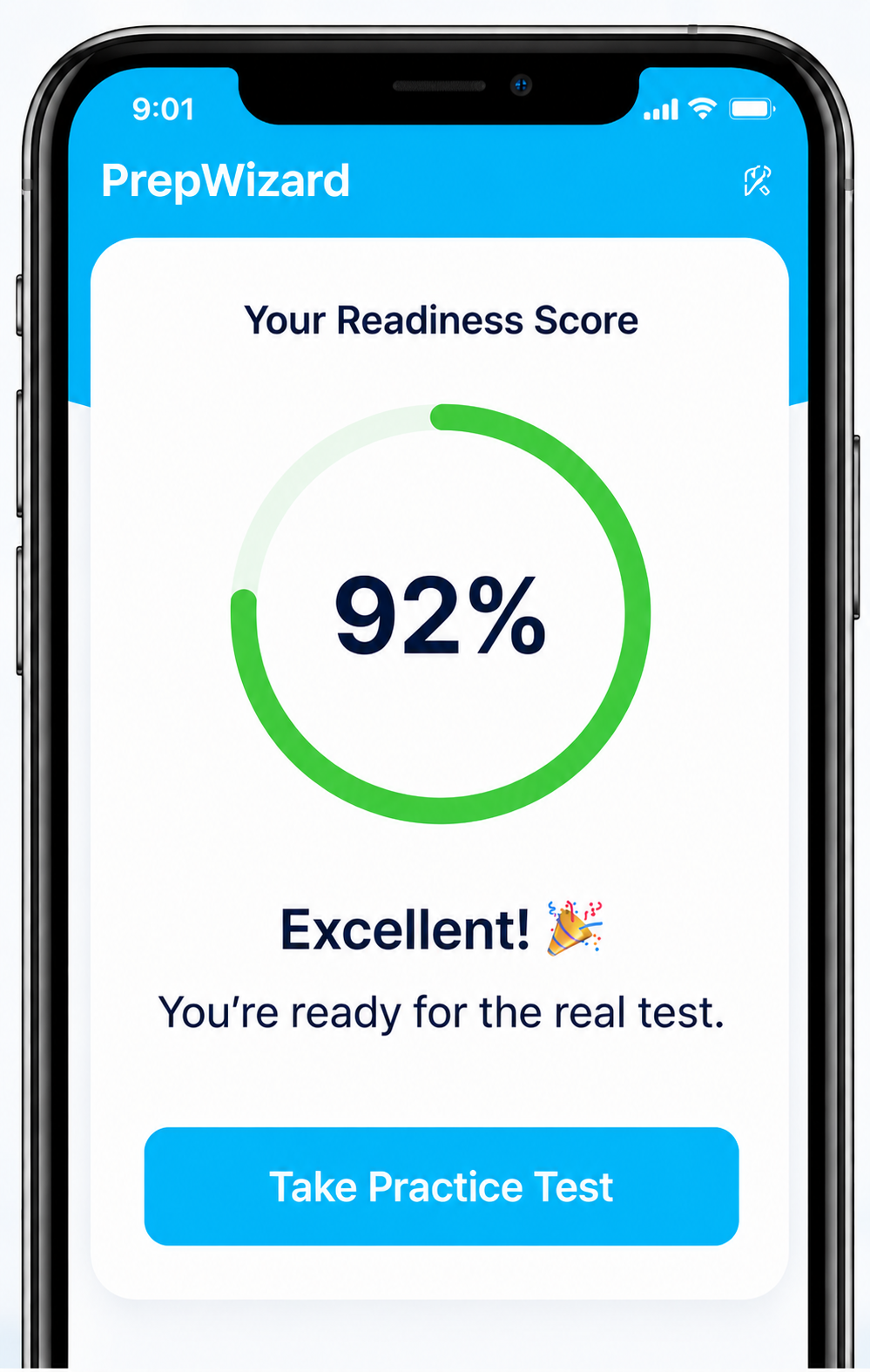 Sample readiness screen
Choose an answer to continue.
Questions about your course? Call 1-800-482-6593.
Choose your county or area to find local driver education information and links to its cities and communities.
Place names and county relationships: 2020 U.S. Census reference files. Includes county equivalents and census-designated communities.